
 https://www.parryfield.com/wp-content/uploads/2025/05/towfiqu-barbhuiya-2Xht5D22y0I-unsplash-scaled.jpg
1708
2560
Tasha Fraser
https://www.parryfield.com/wp-content/uploads/2019/07/Parry-Field-Lawyers-Logo.png
Tasha Fraser2026-09-15 08:46:122026-09-15 11:04:03How to Review your Charity’s Governance Procedures
https://www.parryfield.com/wp-content/uploads/2025/05/towfiqu-barbhuiya-2Xht5D22y0I-unsplash-scaled.jpg
1708
2560
Tasha Fraser
https://www.parryfield.com/wp-content/uploads/2019/07/Parry-Field-Lawyers-Logo.png
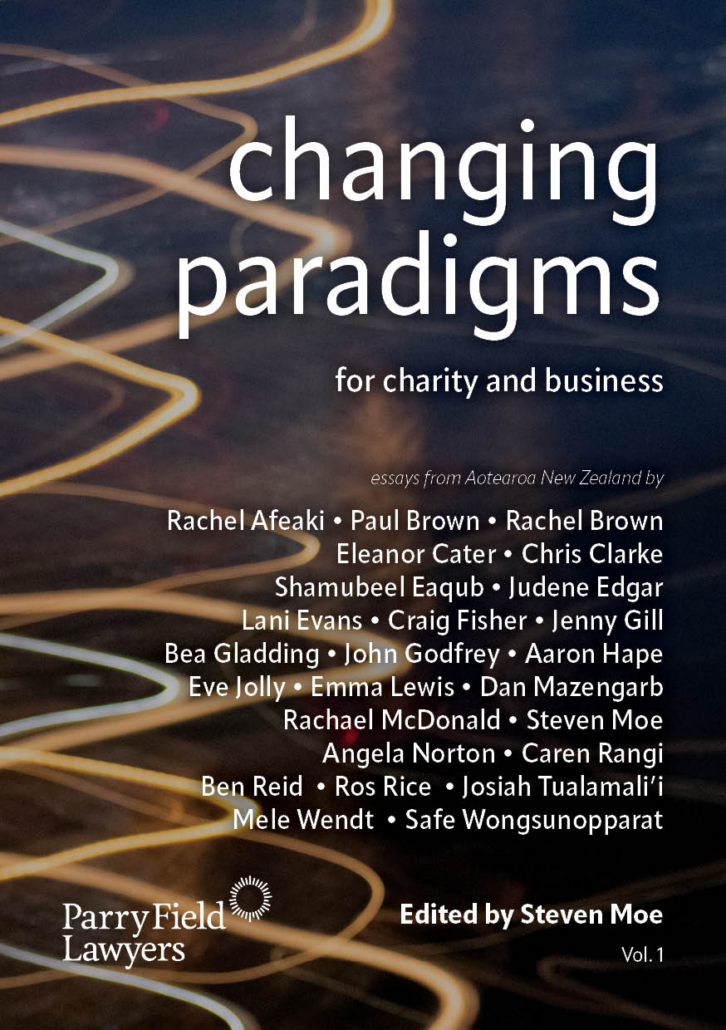
Tasha Fraser2026-09-15 08:46:122026-09-15 11:04:03How to Review your Charity’s Governance ProceduresChanging Paradigms is a collection of essays from 25 contributors across Aotearoa New Zealand, edited by Steven Moe, Partner at Parry Field Lawyers and host of Seeds podcast.
The book includes many thought provoking articles from contributors who are each experts in their fields, and covering a diverse range of topics – Youth and Charities, the Economy, challenges for Governance, AI, the role of Funders, Pasifika insights, Impact Investing, and a whole lot more.
The book is free to download.
Thank you to those who have taken the time to contribute to the book, as well as to those whose support has made publication possible:
- Rachel Afeaki
- Paul Brown
- Rachel Brown
- Eleanor Cater
- Chris Clarke
- Shamubeel Eaqub
- Judene Edgar
- Lani Evans
- Craig Fisher
- Jenny Gill
- Bea Gladding
- John Godfrey
- Aaron Hape
- Eve Jolly
- Emma Lewis
- Dan Mazengarb
- Rachael McDonald
- Angela Norton
- Caren Rangi
- Ben Reid
- Ros Rice
- Josiah Tualamali’i
- Mele Wendt
- Safe Wongsunopparat
Download a free digital copy of Changing Paradigms below.
“It was a real privilege to be part of this project and I think it has the potential to become a foundational piece of work that helps shift how we think about the relationship between philanthropy and business in New Zealand.”
Aaron Hape, via LinkedIn
Chair of the Te Papa Foundation
“Changing Paradigms brings together a diverse range of local voices exploring governance and leadership in the for-purpose space. What I really appreciated is the strength-based, grounded perspective—real experiences, diverse thinking, with a strong sense of purpose woven throughout.
It really affirms the importance of meeting organisations where they are and building from what is already strong. It’s also a helpful reminder that good governance is relational, values-led, and always evolving alongside the communities we serve.”
Karen Stockmann
Community Advisor, Community Waikato
“The writers have different lenses, but the conclusions have commonalities – charities and funders need to work differently. From practical shifts like participatory decision-making, to longer-term investment, collaboration and effectively engaging with tools like AI, the overall message is that we need to keep building systems that give communities more control, create lasting change, and make better use of time and money. And, I hope, move us closer to models of mutual aid.”
Lani Evans, via LinkedIn
Co-Founder and CEO, Fundsorter
“There’s a strong thread running through the series about partnership, fresh thinking on governance, and long term stewardship. There are thoughts and ideas that are practical rather than overly theoretical. The essays are short, varied, and easy to read. You can dip in and out without needing a quiet weekend to plough through them all. Overall, this compilation comes across less like a dry textbook to endure, and more like a set of conversations to kick start better thinking for anyone curious about where the “for purpose” and business worlds might proceed. “
Not For Profit Resource, April 2026 Newsletter
Recent Articles
https://www.parryfield.com/wp-content/uploads/2025/05/towfiqu-barbhuiya-2Xht5D22y0I-unsplash-scaled.jpg
1708
2560
Tasha Fraser
https://www.parryfield.com/wp-content/uploads/2019/07/Parry-Field-Lawyers-Logo.png
Tasha Fraser2026-09-15 08:46:122026-09-15 11:04:03How to Review your Charity’s Governance Procedures https://www.parryfield.com/wp-content/uploads/2026/08/dylan-gillis-KdeqA3aTnBY-unsplash-scaled.jpg
1707
2560
marapizarras@parryfield.com
https://www.parryfield.com/wp-content/uploads/2019/07/Parry-Field-Lawyers-Logo.png
marapizarras@parryfield.com2026-08-31 17:52:252026-08-31 18:08:27Trustee Liabilities: Demystifying your role
https://www.parryfield.com/wp-content/uploads/2026/08/dylan-gillis-KdeqA3aTnBY-unsplash-scaled.jpg
1707
2560
marapizarras@parryfield.com
https://www.parryfield.com/wp-content/uploads/2019/07/Parry-Field-Lawyers-Logo.png
marapizarras@parryfield.com2026-08-31 17:52:252026-08-31 18:08:27Trustee Liabilities: Demystifying your role https://www.parryfield.com/wp-content/uploads/2026/08/mitchell-luo-H3htK85wwnU-unsplash-scaled.jpg
1707
2560
marapizarras@parryfield.com
https://www.parryfield.com/wp-content/uploads/2019/07/Parry-Field-Lawyers-Logo.png
marapizarras@parryfield.com2026-08-31 17:49:302026-08-31 18:08:30What Powers do the Trustees of Charitable Trusts have?
https://www.parryfield.com/wp-content/uploads/2026/08/mitchell-luo-H3htK85wwnU-unsplash-scaled.jpg
1707
2560
marapizarras@parryfield.com
https://www.parryfield.com/wp-content/uploads/2019/07/Parry-Field-Lawyers-Logo.png
marapizarras@parryfield.com2026-08-31 17:49:302026-08-31 18:08:30What Powers do the Trustees of Charitable Trusts have?