Now is a great time to consider whether the legal vehicle of your society is best serving your needs. We’ve outlined the pros and cons of Incorporated Societies and Charitable Trusts as entities here.

If you believe a Charitable Trust is right for you, we can help you transition from an incorporated society. The process if relatively straightforward but can take some time. A few key points to consider are:

  1. Bequests – have you received many bequests in the past?  Once your current incorporated society is wound up, there is a chance that a bequest meant for you may not find its way to the new entity.  There are ways to help prevent this (e.g. notifying key stakeholders that they should update their will, keeping the same charities services number or even keeping the society as a shell for a period of time), but it is still a risk.
  2. Accounting input – We strongly advise seeking accounting input throughout the transition process, as there may be tax obligations or timing obligations that you need to aware of.  If you don’t have a regular accountant then we can point you towards specialists in this area.
  3. Employees – if you have any employees, you need to make sure you engage with them throughout the process and give them time to consider the change.  We have a specialist employment team who can help you throughout this process.
  4. Contracts – you will need to move any contracts across to the new entity and inform key stakeholders of the change – this can take time.  If you own any property, this would need to be transferred too. We and our specialist property team could assist throughout this process.
  5. IRD and Charities Services numbers – you will need to apply for a new IRD number. If you have tax donee status, this will need to transition from the society to the charitable trust. The good news is you can keep your number with Charities Services despite moving to a different type of entity.
  6. Taking people on the journey with you – it’s so important to take members and stakeholders on the journey with you.  This means it can take some time to transition, but is well worth it when it comes time to vote.

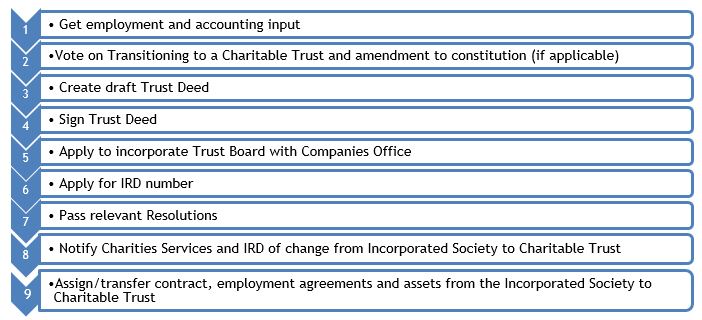
Here’s what the transitioning process would look like:

Parry Field Lawyers could help with each step of the process. If you have any further queries please do not hesitate to contact one of our experts at Parry Field Lawyers.

This article is general in nature and is not a substitute for legal advice. You should talk to a lawyer about your specific situation. Reproduction is permitted with prior approval and credit being given back to the source. 

In September 2023, the regulations for the Incorporated Societies Act 2022 (the “new Act”) were released.  So what do you need to know?

Alternative method of filing documents may be allowed by the registrar where it is not practicable for the society to use the Incorporated Societies website (although this is preferred).

Infringement fees listed in the draft regulations have been kept the same (table below). There is no cap for the amount of fees a society can receive if multiple offences occur at the same time. The infringement process has also been released.

Nature of Infringement Offence Fee
Failure to notify the Registrar of amendments to the constitution $100
Failure to notify the Registrar of elections or appointments and other changes relating to officers $100
Failure to maintain a register of members $100
Failure to call annual general meeting $500
Failure to properly hold, and keep minutes of, annual general meetings $500
Failure to send copy of passed resolution in lieu of meeting to certain members $200
Failure to register financial statements $500
Failure to register an annual return $100
Failure to have a registered office $100
Failure to give the Registrar notice of change of contact person $200

Transitional period until 5 October 2028 allows for a) societies to continue to restrict AGM attendance, if their constitution allowed it prior to 5 October 2023; and b) have more than 50% independent officers on their committee, if their constitution allows.

Members’ register must include past members, but only those who ceased to be a member within the last seven years.

Application for re-registration will include the prescribed information set out in the Regulations, which we have explained in our article here.

With the new Act comes a lot of changes to the requirements for an incorporated society’s constitution. We have helped many incorporated societies over the years and would be happy to discuss your situation with you, especially when it comes to amending your society’s constitution so it meets the requirements set out in the new Act. You can contact us any time by email or phone.

We have a lot more resources at this page dedicated to the Incorporated Societies Act 2022.

This article is not a substitute for legal advice and you should consult your lawyer about your specific situation. Please feel free to contact us at Parry Field Lawyers.

From 5 October 2023 until 5 April 2026, all 24,000 incorporated societies in New Zealand must re-register under the Incorporated Societies Act 2022 (the “new Act”).

So what does this mean for you and your society?  In this article we’ll set out what you need to know ahead of the re-registration period.


What will re-registration involve?

Companies Office wants to make the re-registration process as simple as possible with no fees.  There will be an online form to complete with a few key pieces of information for your society:

  • New Zealand Business Number and registration number;
  • the physical address of your proposed registered office;
  • your balance date;
  • who your contact person is;
  • the names of the proposed officers and for each officer:
    • their physical address (note this won’t be publicly available);
    • their written consent to being an officer; and
    • a certificate confirming they are not disqualified from holding office as an officer – Companies Office have made a template for this available here;
  • confirmation your society has 10 members; and
  • confirmation that an officer considers the proposed constitution complies with the Act.

Your society will also need to upload a constitution that complies with the new Act.  We have done a series of six articles on this topic which you can find on our Information Hub.  We are helping many incorporated societies review and update their constitutions in preparation for the new Act – if this is something you would like assistance with, please feel free to get in touch.


What can you do to prepare?

Now is a great time to take a look at your constitution and practices to make sure they are fit for purpose under the new Act.  Do you have a disputes resolution procedure?  How do you deal with conflicts of interest?  We have lots of information on how the new Act will affect your society available on our Information Hub and are happy to help your society to prepare.  You can contact us anytime by email or phone.

This article is not a substitute for legal advice and you should consult your lawyer about your specific situation. Please feel free to contact us at Parry Field Lawyers.

Introduction

The Incorporated Societies Act 2022 (the “new Act”) recently received Royal Assent, resulting in significant changes for the 24,000 incorporated societies in New Zealand. The new Act replaces the Incorporated Societies Act 1908, which has been long overdue for an upgrade. We have discussed ten key changes for incorporated societies to be aware of in our article here.

In this article we will do a deep dive into one of the many changes in the new Act, namely the conflict of interest disclosure procedure. This will be important for incorporated societies to get right to ensure those involved are not conflicted, or if they are that the conflicts are disclosed.

When an officer has interest in a matter

The new Act requires an officer to disclose when they are interested in “a matter”. A matter is defined in section 62(4) of the new Act as meaning a society’s performance of its activities or exercise of its powers, or a transaction made or entered into, or proposed to be entered into, by the society.

Under section 62 of the new Act, an officer is interested in a matter if they or one of their relatives may obtain financial benefit from the matter, or they or one of their relatives may have a financial interest in a person to whom the matter relates, or they are interested in the matter because the society’s constitution says so. However, an officer is not interested in a matter:

  • simply because they receive indemnity, insurance cover, remuneration, or other benefits authorised under the new Act; or
  • if the officer’s interest is the same or substantially the same as the benefit or interest of all or most other members of the society due to their membership; or
  • if the officer’s interest is so remote or insignificant that it cannot reasonably be regarded as likely to influence the officer in carrying out their responsibilities under the Act or the society’s constitution; or
  • the officer’s interest is of a kind that is specified in the society’s constitution for the purposes of section 62(2)(d).

The starting point then is to work out if there is a conflict using those criteria. Not everything is a conflict.

Duty of disclosure

If an officer is interested in a matter relating to the society, under section 63 of the new Act they must disclose the details of the nature and extent of the interest (where possible including monetary value of the interest) to the committee and record it on the interests register (discussed below). This disclosure must be made as soon as practicable after the officer becomes aware of their interest in the matter.

The interests register

The interests register is a register of all of the disclosures made by officers under section 63. It is kept and maintained by the committee, and may be inspected by an officer at any reasonable time as set out in section 73 of the new Act.

Consequences of an officer’s interest

As a result of their interest in the matter, the officer cannot vote or take part in a decision of the committee relating to the matter or sign any document relating to the entry into a transaction or the initiation of the matter, as set out in section 64(1)(a)-(b) of the new Act. However, the officer can take part in discussion relating to the matter and be present when the committee are making a decision (unless the committee decides otherwise). All of the officers who are not interested in the matter can consent to the interested officer doing the acts set out in section 64(1)(a)-(b), thereby allowing the interested officer to do any of these acts. Despite this, if half or more of the officers are interested in the matter and therefore cannot vote, the committee must call a special general meeting to determine the matter under section 64(3).

Notice to members in certain circumstances

If an officer does not disclose their interest in a matter under section 63 or is interested in a matter but still takes part in a vote, decision making or signing of documents in relation to the matter in contravention of section 64, then the committee must notify the members of the society in accordance with section 65(1) of the new Act. This notice would be of the failure to comply with section 63 or 64 and should list any transactions affected, and be sent out as soon as practicable after the committee becomes aware of the failure.

Where an officer is interested in a transaction, section 68(1) of the new Act allows a society to avoid the transaction up to three months after the society has notified its members under section 65(1). It’s not as easy as that, though – there are further limitations set out below.

Permissible amendments to the conflict of interest disclosure procedure

There is some flexibility here. The new Act gives a society the ability to negate, limit or modify the above (except for section 62, which explains when an officer has an interest in a matter). Under section 67 of the new Act, a society’s constitution may negate, limit or modify any provisions of sections 63, 64, 65(1) and 73 as long as the changes still satisfy the conditions prescribed by the regulations (if any).

The society’s constitution may also negate or limit the society’s ability to avoid a transaction under section 68(1) as long as the changes still satisfy the conditions prescribed by the regulations (if any). This means, for example, a society could require two thirds of officers to be interested in the matter before a special general meeting is called to determine the matter rather than half. We have prepared detailed notes on what your constitution must contain under the new Act which are available here, and can help you to consider your options in relation to your conflict of interest disclosure procedure.

What cannot be changed

There are some parts of the new Act that cannot be altered by the society’s constitution:

  • Section 65(2)-(3), which explains that any failure to comply with section 63 or 64 does not affect the validity of the new act, but this does not limit a person’s right to apply for judicial review.
  • Section 66, which says that regulations may require every member of the society to be notified or for notification to be made to the members as a group.
  • Section 68(2)-(4), which says that a transaction cannot be avoided under section 68(1) (discussed earlier) where the society received fair value under it. Fair value is defined in section 69 and the onus of proving fair value is set out in section 70. Additionally, a transaction can only be avoided on the ground of the officer’s interest, and a constitution cannot allow a transaction to be avoided in any circumstances other than those set out in the new Act.
  • Section 71, which explains that if a third party has acquired property from a person other than the society for valuable consideration and without knowledge of the circumstances of the transaction under which the other person initially acquired the property from the society, the avoidance of a transaction will not affect the third party’s title or interest to or in the property.
  • Section 72, which reiterates that the conflict of interest procedure does not apply in relation to salary, wages or other payments paid to officers in accordance with section 24(1)(h), or an indemnity given or insurance provided in accordance with subpart 6.

Summary

With the new Act comes a lot of changes to the requirements for an incorporated society’s constitution. We have helped many incorporated societies over the years and would be happy to discuss your situation with you, especially when it comes to amending your society’s constitution so it meets the requirements set out in the new Act. You can contact us any time by email or phone.

We have a lot more resources at this page dedicated to the Incorporated Societies Act 2022.

This article is not a substitute for legal advice and you should consult your lawyer about your specific situation. Please feel free to contact us at Parry Field Lawyers.


Introduction

The Incorporated Societies Act 2022 (the “new Act”) recently received Royal Assent, resulting in significant changes for the 24,000 incorporated societies in New Zealand. The new Act replaces the Incorporated Societies Act 1908 (the “old Act”), which has been long overdue for an upgrade. We have discussed ten key changes for incorporated societies to be aware of in our article here and provided a lot of detailed information in the form of articles and seminars here. Contact us for a copy of our comprehensive handbook.

All incorporated societies will be required to reregister under the new Act by the 5th of April 2026. Section 26 of the new Act sets out what a society’s constitution must contain. This is important as the society’s constitution must comply with the new Act in order to reregister. We have detailed notes on the reregistration process here and are helping many comply with the requirements.

In a series of six articles we have set out the key requirements for your society’s updated constitution, as prescribed by section 26 of the new Act. This article will discuss what your constitution needs to provide in relation to governance.

Name

Similar to the old Act, the new Act requires the society’s constitution to include its name. The new Act also explains the Registrar must refuse to incorporate a society under a particular name in the circumstances set out in section 11 of the new Act, such as:

  • the use of the name would contravene legislation;
  • the name is identical or almost identical to the name of another society, company or body corporate; or
  • where the name does not include the word “Incorporated”, “Inc”, or “Manatōpū” (or 2 or more of those words) as the last word or words of the name.

Purposes

The new Act requires the society’s constitution to include its purposes, which is similar to the requirements of the old Act. Under section 12 of the new Act, the Registrar must refuse to incorporate a society if its purposes include an unlawful purpose or a purpose of carrying on the society for the financial gain of any of its members.

Control and management of finances

Similar to the old Act, the new Act requires the constitution to provide for how the society will control and manage its finances.

Winding up

The new Act expands on the old Act, setting out particular requirements for the distribution of the society’s property on liquidation. The society’s constitution must nominate a not-for-profit entity, or a class or description of not-for-profit entities, to which any of the society’s surplus assets should be distributed on liquidation or removal from the register. Under section 216 of the new Act, the surplus is the remaining assets of the society after all of the costs, debts and liabilities have been paid. Section 216 also sets out what happens where more than one not-for-profit entity has been nominated in the society’s constitution. Section 5(3) of the new Act defines a not-for-profit entity and subpart 5 of part 5 sets out other matters relating to the removal or liquidation of a society.

Summary

With the new Act comes a lot of changes to the requirements for an incorporated society’s constitution. We have helped many incorporated societies over the years and would be happy to discuss your situation with you, especially when it comes to amending your society’s constitution so it meets the requirements set out in the new Act. You can contact us any time by email or phone.

We have a lot more resources at this page dedicated to the Incorporated Societies Act 2022.

More from this series

The new Incorporated Societies Act 2022 and your constitution: What has changed for membership?

The new Incorporated Societies Act 2022 and your constitution: What has changed for governance?

The new Incorporated Societies Act 2022 and your constitution: Requirements for general meetings

The new Incorporated Societies Act 2022 and your constitution: Amendment procedures

The new Incorporated Societies Act 2022 and your constitution: Dispute resolution procedures


The information contained in this outline is of a general nature, should only be used as a guide and does not amount to legal advice. It should not be used or relied upon as a substitute for detailed advice or as a basis for formulating decisions. Special considerations apply to individual fact situations. Before acting, clients should consult their Parry Field Lawyer.


Introduction

The Incorporated Societies Act 2022 (the “new Act”) recently received Royal Assent, resulting in significant changes for the 24,000 incorporated societies in New Zealand. The new Act replaces the Incorporated Societies Act 1908 (the “old Act”), which has been long overdue for an upgrade. We have discussed ten key changes for incorporated societies to be aware of in our article here and provided a lot of detailed information in the form of articles and seminars here. Contact us for a copy of our comprehensive handbook.

All incorporated societies will be required to reregister under the new Act, so it is a chance to revisit all aspects of these organisations. Section 26 of the new Act sets out what a society’s constitution must contain. This is important as the society’s constitution must comply with the new Act in order to reregister. We have detailed notes on the reregistration process here and are helping many comply with the requirements.

In a series of six articles we have set out the key requirements for your society’s updated constitution, as prescribed by section 26 of the new Act. This article will discuss what your constitution needs to provide in relation to disputes resolution procedures.

Dispute resolution procedures

Unlike the old Act, the new Act requires the society’s constitution to include dispute resolution procedures, including provision for how a complaint may be made, in accordance with sections 38 to 44.

  • A society can develop its own dispute resolution procedures, so long as those procedures are consistent with natural justice. This is provided for by section 39 of the new Act.
  • Clauses 2 to 8 of schedule 2 sets out disputes resolution procedures a society may decide to include. Should a society include the schedule 2 procedures, its dispute resolution procedures will be presumed to be consistent with natural justice according to section 41 of the new Act.
  • If a society’s constitution does not contain dispute resolution procedures, under clause 6 of schedule 1 the constitution will be treated as including those procedures set out in the Act.

Summary

With the new Act comes a lot of changes to the requirements for an incorporated society’s constitution. We have helped many incorporated societies over the years and would be happy to discuss your situation with you, especially when it comes to amending your society’s constitution so it meets the requirements set out in the new Act. You can contact us any time by email or phone.

We have a lot more resources at this page dedicated to the Incorporated Societies Act 2022.


This article is not a substitute for legal advice and you should consult your lawyer about your specific situation. Please feel free to contact us at Parry Field Lawyers.

More from this series

The new Incorporated Societies Act 2022 and your constitution: What has changed for membership?

The new Incorporated Societies Act 2022 and your constitution: What has changed for governance?

The new Incorporated Societies Act 2022 and your constitution: Requirements for general meetings

The new Incorporated Societies Act 2022 and your constitution: Amendment procedures

The new Incorporated Societies Act 2022 and your constitution: Name, purposes and winding up

The new Incorporated Societies Act 2022: Reregistering your society

Introduction

The Incorporated Societies Act 2022 (the “new Act”) recently received Royal Assent, resulting in significant changes for the 24,000 incorporated societies in New Zealand. The new Act replaces the Incorporated Societies Act 1908 (the “old Act”), which has been long overdue for an upgrade. We have discussed ten key changes for incorporated societies to be aware of in our article here and provided a lot of detailed information in the form of articles and seminars here. Contact us for a copy of our comprehensive handbook.

All incorporated societies will be required to reregister under the new Act, so it is a chance to revisit all aspects of these organisations. Section 26 of the new Act sets out what a society’s constitution must contain. This is important as the society’s constitution must comply with the new Act in order to reregister. We have detailed notes on the reregistration process here and are helping many comply with the requirements.

In a series of six articles we have set out the key requirements for your society’s updated constitution, as prescribed by section 26 of the new Act. This article will discuss what your constitution needs to provide in relation to amendment procedures.

Amendment procedures

The new Act includes guidance around the amendment procedures to be included in the society’s constitution.

Under section 30 of the new Act a society may amend its constitution in the manner provided by the constitution, but every amendment must be:

  • in writing;
  • approved at a general meeting by a resolution passed by the relevant majority (discussed below) required by the constitution (or by resolution passed in lieu of a meeting in accordance with section 89 of the new Act); and
  • otherwise made in accordance with the society’s constitution.

This procedure must be set out in the society’s constitution, including whether the relevant majority is a simple majority or a higher majority and any additional requirements beyond those set out in section 30 of the new Act. Under the new Act a relevant majority means either:

  • a simple majority of the votes of those members entitled to vote and voting on the issue; or
  • where a higher majority is required by the society’s constitution, that higher majority of the votes of those members entitled to vote and voting on the issue.

Minor amendments

Section 31 of the new Act sets out the procedure for minor or technical amendments. Such amendments have no more than a minor effect, correct errors or make similar technical alterations. Where there needs to be a minor or technical amendment to the constitution, the committee must ensure written notice of the amendment is sent to every member in accordance with the society’s constitution. This notice must include the text of the amendment and the member’s right to object to the amendment. If the committee does not receive an objection from a member within 20 working days after the date on which the notice was sent (or any longer period specified in the constitution), the committee may make the amendment. If an objection is received, then the committee may not make an amendment. This section 31 procedure must be set out in the society’s constitution.

Summary

With the new Act comes a lot of changes to the requirements for an incorporated society’s constitution. We have helped many incorporated societies over the years and would be happy to discuss your situation with you, especially when it comes to amending your society’s constitution so it meets the requirements set out in the new Act. You can contact us any time by email or phone.

We have a lot more resources at this page dedicated to the Incorporated Societies Act 2022.

This article is not a substitute for legal advice and you should consult your lawyer about your specific situation. Please feel free to contact us at Parry Field Lawyers.

More from this series

The new Incorporated Societies Act 2022 and your constitution: What has changed for membership?

The new Incorporated Societies Act 2022 and your constitution: What has changed for governance?

The new Incorporated Societies Act 2022 and your constitution: Requirements for general meetings

The new Incorporated Societies Act 2022 and your constitution: Dispute resolution procedures

The new Incorporated Societies Act 2022 and your constitution: Name, purposes and winding up

Introduction

The Incorporated Societies Act 2022 (the “new Act”) recently received Royal Assent, resulting in significant changes for the 24,000 incorporated societies in New Zealand. The new Act replaces the Incorporated Societies Act 1908 (the “old Act”), which has been long overdue for an upgrade. We have discussed ten key changes for incorporated societies to be aware of in our article here and provided a lot of detailed information in the form of articles and seminars here. Contact us for a copy of our comprehensive handbook.

All incorporated societies will be required to reregister under the new Act, so it is a chance to revisit all aspects of these organisations. Section 26 of the new Act sets out what a society’s constitution must contain. This is important as the society’s constitution must comply with the new Act in order to reregister. We have detailed notes on the reregistration process here and are helping many comply with the requirements.

In a series of six articles we have set out the key requirements for your society’s updated constitution, as prescribed by section 26 of the new Act. This article will discuss what your constitution needs to provide in relation to governance.

Committee

The old Act only required a society to have officers. Under the new Act, a society must have a committee. The society’s constitution must include the composition, roles, functions, powers and procedures of the society. This involves several requirements discussed below and in other articles in this series, which you can find here.

The society’s constitution must include the number of members that must or may be on the committee. Under section 45 of the new Act, the committee must comprise of 3 or more officers who are qualified to be elected or appointed under section 47 (discussed below). A majority of the officers must also be members of the society or representatives of bodies corporate that are members of the society.

Appointment of officers

The society’s constitution must include the requirements for the election and appointment of officers. Section 47 of the new Act sets out the qualifications of officers, including that the officer:

  • is a natural person;
  • has consented in writing to be an officer; and
  • certifies they are not disqualified under section 47(3) of the new Act.

There is a long list of disqualifications under section 47(3) of the new Act, but this list is largely similar to that in legislation regulating other legal entities. Someone under 16 years of age or someone who is an undischarged bankrupt are examples of persons who are disqualified from being elected or appointed as an officer. A society could include the qualifications of officers alongside the procedure for election or appointment of officers in its constitution, although the qualifications of officers could also be kept as a separate policy document.

Functions and powers

The society’s constitution must also include the functions and powers of the committee. These are set out in section 46 of the new Act, which says that the committee’s function is to manage or directly supervise the operation and affairs of a society. Accordingly, the committee has all the powers necessary for managing, and for directing and supervising the management of, the operation and affairs of the society.

Removal of officers

The new Act requires the society’s constitution to include the grounds for an officer’s removal from office. Section 50 of the new Act says that an officer may cease to be an officer if they are removed in accordance with the society’s constitution, or if the officer:

  • resigns;
  • becomes disqualified from being an officer under section 47(3);
  • dies; or
  • otherwise vacates office in accordance with the society’s constitution.

Further requirements 

The new Act requires the constitution to also include the following information:

  • the terms of office of the officers;
  • how the chairperson (if any) will be elected or appointed and whether that person will have a casting vote if there is an equality of votes; and
  • the quorum and procedure for committee meetings, including voting procedures.

The intention behind all of these new requirements is to improve governance for incorporated societies by setting out how they need to act.

Contact person

Section 113 of the new Act introduces a new requirement for a society to have at least one contact person at all times (and it may have up to 3 contact people). The purpose of this requirement is for the society to have someone the Registrar can contact when needed. The contact person must be at least 18 years old and ordinarily resident in New Zealand (in accordance with section 114 of the new Act).

How the contact person or persons will be elected or appointed must be set out in the society’s constitution.

Summary

With the new Act comes a lot of changes to the requirements for an incorporated society’s constitution. We have helped many incorporated societies over the years and would be happy to discuss your situation with you, especially when it comes to amending your society’s constitution so it meets the requirements set out in the new Act. You can contact us any time by email or phone.

We have a lot more resources at this page dedicated to the Incorporated Societies Act 2022.

This article is not a substitute for legal advice and you should consult your lawyer about your specific situation. Please feel free to contact us at Parry Field Lawyers.

More from this series

The new Incorporated Societies Act 2022 and your constitution: What has changed for membership?

The new Incorporated Societies Act 2022 and your constitution: Requirements for general meetings

The new Incorporated Societies Act 2022 and your constitution: Amendment procedures

The new Incorporated Societies Act 2022 and your constitution: Dispute resolution procedures

The new Incorporated Societies Act 2022 and your constitution: Name, purposes and winding up

Introduction

The Incorporated Societies Act 2022 (the “new Act”) recently received Royal Assent, resulting in significant changes for the 24,000 incorporated societies in New Zealand. The new Act replaces the Incorporated Societies Act 1908 (the “old Act”), which has been long overdue for an upgrade. We have discussed ten key changes for incorporated societies to be aware of in our article here and provided a lot of detailed information in the form of articles and seminars here. Contact us for a copy of our comprehensive handbook.

All incorporated societies will be required to reregister under the new Act, so it is a chance to revisit all aspects of these organisations. Section 26 of the new Act sets out what a society’s constitution must contain. This is important as the society’s constitution must comply with the new Act in order to reregister. We have detailed notes on the reregistration process here and are helping many comply with the requirements.

In a series of six articles we have set out the key requirements for your society’s updated constitution, as prescribed by section 26 of the new Act. This article will discuss what your constitution needs to provide in relation to membership.

Number of members

Membership is a key point of difference for incorporated societies compared to other legal forms. It is a source of strength as a member led organisation can draw on the enthusiasm of its member base.

Under section 74 of the new Act, a society must have at least 10 members to register as a society. This is a decrease from the 15 members required under the old Act.

A body corporate is still treated as being 3 members for the purpose of determining the number of members, as per section 14 of the new Act.

There was no continuous minimum membership requirement under the old Act, but section 74 of the new Act dictates that a society must have at least 10 members at all times. This will be something that societies need to keep an eye on – especially smaller ones.

Under section 75 of the new Act, if a society has fewer than 10 members the Registrar may intervene and give the society six months to increase its membership. If the society fails to increase its membership, the Registrar may apply to the High Court to put the society into liquidation or remove the society from the register.

Section 26 of the new Act does not require a society to include the membership minimum in its constitution, but it may wish to do so because of the consequences of falling below 10 members.

Member details

Both the old Act and the new Act provide that a society’s constitution must set out how a person becomes a member of the society and how a person ceases to be a member of the society.

The new Act stipulates that a society’s constitution must contain a requirement that a person consents to being a member of the society. Consent is required under section 76 of the new Act, which also explains the consent of a body corporate may be given on its behalf in writing by a person acting under the body corporate’s express or implied authority.

Under section 79 of the new Act, a society must keep a register of its members which contains the following details for each member:

  • name;
  • last known contact details (which at least includes a phone number, along with a physical or email address);
  • the date on which they became a member; and
  • any other information prescribed by the regulations (if any).

The society’s register must be updated as soon as practicable after the society becomes aware of the need for an update. The society’s constitution must include its arrangements for keeping its register up to date according to these requirements set out in section 79 of the new Act.

Summary

With the new Act comes a lot of changes to the requirements for an incorporated society’s constitution. We have helped many incorporated societies over the years and would be happy to discuss your situation with you, especially when it comes to amending your society’s constitution so it meets the requirements set out in the new Act. You can contact us any time by email or phone.

We have a lot more resources at this page dedicated to the Incorporated Societies Act 2022.

This article is not a substitute for legal advice and you should consult your lawyer about your specific situation. Please feel free to contact us at Parry Field Lawyers.

More from this series

The new Incorporated Societies Act 2022 and your constitution: What has changed for governance?

The new Incorporated Societies Act 2022 and your constitution: Requirements for general meetings

The new Incorporated Societies Act 2022 and your constitution: Amendment procedures

The new Incorporated Societies Act 2022 and your constitution: Dispute resolution procedures

The new Incorporated Societies Act 2022 and your constitution: Name, purposes and winding up

Following the introduction of the new Incorporated Societies Act 2022 (the “new Act”) there are many changes that will be relevant to your society.

One really big change is existing societies will need to reregister under the new Act. A consequence of not reregistering is that the society will cease to exist from 5 April 2026 according to Companies Office guidance. While there is still time, it would be prudent for societies registered under the Incorporated Societies Act 1908 (the “old Act”) to understand how to reregister under this new regime. If this is you, a review of your rules is needed to ensure it complies with these new regulations. We have written a series of articles on the requirements for your constitution under the new Act, which you can find here.

How do I reregister my society?

The first schedule to the new Act sets out the process for existing societies under the old Act to reregister as societies under the new Act. Until the transition date or until reregistration, the old Act will still apply to existing societies. Before that date, a society can apply to the Registrar of Incorporated Societies to be reregistered as long as it is not in liquidation. Provided all the requirements for incorporation under the new Act are met, the society will be reregistered.

What is needed in an application to be reregistered?

Clause 5 provides for the necessary documents and information needed in an application. Namely, that an application must be created in a manner prescribed by the regulations and have in it, or accompanied with it:

  • The information prescribed by the regulations; and
  • The society’s proposed name;
  • At least 1 contact person’s name and contact details;
  • A copy of the society’s proposed constitution; and
  • The fee prescribed by the regulations.

‘Regulations’ mean the regulations as set out in the new Act. An existing society may amend its rules in accordance with clause 9 or make a new constitution in accordance with clause 10 to ensure they comply with the new Act’s requirements. We have written a series of articles on the requirements for your constitution under the new Act, which you can find here.

Reregistration by the registrar

To issue a society with a certificate of incorporation and register a society’s name and constitution, the Registrar must be satisfied with the society’s application for reregistration. Additionally, the grounds in section 8 and 11 to 13 must not apply. These are grounds for the Registrar to refuse to incorporate a society, including:

  • the society is ineligible to be an incorporated society;
  • the society’s name does not comply with the requirements;
  • the society’s purposes do not comply with the new Act; and
  • the society’s constitution does not comply with the new Act.

However, if any of these grounds apply, the Registrar may still reregister the society subject to terms and conditions ensuring the grounds are addressed within a reasonable time. If the grounds are not addressed the society may be removed by the Registrar.

What happens to your society after reregistering?

Clause 11 of the new Act provides that upon reregistration a society will continue as the same legal entity – it does not create a whole new legal entity. Subject to the rights or obligations imposed on the society by the new Act or its constitution, the property, rights and obligations of the existing society are not affected by reregistration. Similarly, any proceedings the existing society is involved in (or will  be involved in) can continue (or commence) following reregistration, as set out in clause 11(5).

 What are the consequences of not reregistering?

Where an existing society does not reregister and is still incorporated under the old Act, upon the transition date, they will cease to exist and be deemed under the new Act to have been removed by the Registrar as per clause 12. If this happens its surplus assets will be distributed according to part 5 subpart 5 of the new Act. However, the Registrar, or the court in prescribed circumstances, has the power to restore an existing society to the register under section 185 or section 188. Note this cannot be done if six years has passed since the existing society ceased to exist. Clause 12(3) of schedule 1 sets out what happens where a society’s application to reregister has not been fully determined by the transition date.

Summary

With the new Act comes a lot of changes to the requirements for an incorporated society’s constitution. We have helped many incorporated societies over the years and would be happy to discuss your situation with you, especially when it comes to amending your society’s constitution so it meets the requirements set out in the new Act. You can contact us any time by email or phone.

We have a lot more resources at this page dedicated to the Incorporated Societies Act 2022.


This article is not a substitute for legal advice and you should consult your lawyer about your specific situation. Please feel free to contact us at Parry Field Lawyers.

More from this series

The new Incorporated Societies Act 2022 and your constitution: What has changed for membership?

The new Incorporated Societies Act 2022 and your constitution: What has changed for governance?

The new Incorporated Societies Act 2022 and your constitution: Requirements for general meetings

The new Incorporated Societies Act 2022 and your constitution: Amendment procedures

The new Incorporated Societies Act 2022 and your constitution: Name, purposes and winding up

The new Incorporated Societies Act 2022 and your constitution: Dispute resolution procedures