There are essential requirements that must be met under New Zealand law in order for a company to be incorporated. One such requirement is that a company must have at least one director. In this article we will explain what exactly is needed and who can qualify.

Before doing that it is worth noting that a company must also have a name, one or more shares (equity) and one or more shareholders. These essential requirements must be met in order for a company to exist.

We often get asked whether the directors of New Zealand companies have to be in New Zealand. The simple answer is yes, generally speaking, they must be a resident in New Zealand.

However, directors of New Zealand companies can also be living in Australia, provided they are also a director of an Australian incorporated company. This is because Australia is an “enforcement country” that New Zealand has reciprocal arrangements with.

Apart from that exception – who counts as a “resident director”? It has been accepted by the High Court that it is someone physically present in New Zealand for a minimum of 183 days per year.

However, if this 183 day test has not been met, it may still be possible as other relevant factors include:

  • The amount of time spent in New Zealand;
  • The person’s connection to New Zealand;
  • Their ties to New Zealand; and
  • The person’s manner of living when in New Zealand.

In summary, a director needs to be someone living in New Zealand (generally for at least 183 days). Additionally, directors can be persons who live in Australia if they are a director of a company incorporated in Australia. People can also be directors even if they have not been in New Zealand for 183 days provided they have strong connection or ties here.

We help many companies get set up and can answer other questions you may have about that.  Also check out our guide to Doing Business in New Zealand.


This article is general in nature and is not a substitute for legal advice. You should talk to a lawyer about your specific situation. Reproduction is permitted with prior approval and credit being given back to the source. 

We help with capital raising and answering questions all the time. If you would like to discuss further, please contact one of our team on stevenmoe@parryfield.com   sophietremewan@parryfield.com or yangsu@parryfield.com at Parry Field Lawyers

We have reviewed many hundreds of NDAs (aka Non-Disclosure Agreements or sometimes called Confidentiality Agreements).  What are the points that we are reviewing to check for?

These are often used when one party wants to share secrets it has with another – this could be as they are seeking investment, or perhaps they want to explore entering into a long term contract together.

We have a lot of information for companies at our information hub over here, but in this article we want to set out some of the provisions that you should know about, to stay safe.  If you’d like us to look over one you have been sent before you sign it, then just let us know as we can often spot things that are unusual quickly.

In order to upskill you on some key points to watch out for, consider these:

Mutual or one way?
If it is a mutual one then typically it will be more “fair” – as you both need to comply with the provisions.  Even if it is mutual look out for any special carve outs that only apply to one party and not the other eg rights of termination or liability provisions that are more favourable (usually for the person who prepared the draft).

Who holds the power
Like most commercial agreements these are all about negotiating power.  Some companies will only deal with you to explore whether they will talk more if you sign their NDA.  If you are happy with the security you have then it is probably the “key” to enter into those discussions and you just have to weigh up the commercial risks as not having the ability to talk to them will certainly not lead to a contract.

Clear definitions
Spend some time checking how confidential information is defined – most agreements will include things which are labelled as confidential, but does it go as far as to say anything you should know was confidential or anything that was said by phone?  It becomes harder to prove later on if the definitions go that far.  For certainty it can be a strategy to ask that confidential information is written and labelled that way.  Unless it suits you to have a wider definition as you are providing most of the information.

The Purpose
It is common for a purpose of the disclosure to be identified and then reference made to that purpose – that is, the confidential information disclosed needs to be used for the purpose (eg evaluating if the parties will enter into a contract of some kind).  Any time there is a purpose or definition of permitted use check if it is going too far and covering things that are too wide.  Typically there is also a statement about how entering into the NDA is not obligating a party to sign additional agreements related to the purpose – one or both sides might decide to walk away.

Standard of protection
Most agreements will say something about how each party will keep the information safe.  A common standard is that the level of protection is the same level you would use with your own confidential information.

Carve outs for permitted disclosures
An NDA should have some specific carve outs in relation to disclosure that is permitted – typically this will cover sharing with advisors, if required to disclose by a Court or Government body (usually need to notify the other party if this happens), was already in the public domain, later was released by the disclosing party publicly, was already known by the receiving party or was independently developed by the receiver (though that might be hard to prove). Another common carve out covers affiliates of the signing party, provided that the signing party ensures that the affiliate abides by the same obligations under the NDA.

Return or destruction of information
There will usually be a clause saying that at the end of the agreement confidential information will be returned, or destroyed.  While understandable, this is probably hard to comply with given most information is transmitted via email so back ups likely exist on a server, somewhere.  A reference to taking the steps that they can but not requiring a search of all back up files is a practical solution (with a commitment that they will maintain the confidentiality and not use it).

IP Ownership
We would want to see that the original owner of the IP retains ownership of it even if shared with the other party.  There may be a provision about what happens to new IP created based on disclosed information – those usually indicate how a party will want additional agreements to work so can be a good test of the new relationship eg will they own new IP developed based on what you disclose?  NDAs also often make it clear that there is no license granted by the NDA for the information to be used.

Warranties, Indemnities, Remedies
It is common to have provisions that say there is no warranty regarding the information provided (ie that it is accurate, full, fitness for purpose etc).  There is often an indemnity for the discloser if the recipient were to breach the agreement and they suffered loss, and it will often set out what the remedies are if there is a breach (applying to a court to enforce it).

Term
Typically there will be a period of the agreement, so how long is appropriate – 6 months, 1 year, 3 years?  It is common for the obligations to continue on indefinitely, and it is also common for an NDA to be superseded by a later agreement that will set out more about how the parties treat each other.

Who is the counterparty?
It is worth asking this before you sign any contract – is it with the “main entity” or is it with a subsidiary.  If so, does that entity have any assets? Also consider whether the likely harm of breach of the NDA would be financial and/or reputational as this may influence which entity you prefer to be the counterparty.

Governing law
This is actually important just because if you are based in New Zealand but the governing law is California, or Germany, or Japan, then you cannot really know what the law is going to decide over there unless you engage a local lawyer. Your ability to quickly enforce the NDA may also be compromised if a foreign law and/or court is chosen.

What is the real value?
We seldom see NDAs actually enforced because the cost of doing so in a Court is often prohibitive – but what they are good for is signalling intent and a “moral obligation”, showing how the parties will respect intellectual property.  They also start a pattern of relationship and indicate that each party sees it as being important to deal with each other fairly.  Relationships are the real key in business, and they get built through interactions and you get a “sense” of their approach.  For these reasons they are an important part of growing a relationship with the other side.


We hope this has been a helpful overview to upskill you on key things to look for in an NDA.  If you get one that has some “unusual” looking provisions, then feel free to drop us a line to have a look over.

We also have many resources for companies over at our “Start-ups and Capital Raising Information Hub” including downloads like the “Start-ups Legal Toolkit” and the “Capital Raising Guide”.  We hope these are helpful to build up the ecosystem.


This article is general in nature and is not a substitute for legal advice. You should talk to a lawyer about your specific situation. Reproduction is permitted with prior approval and credit being given back to the source. 

The Supreme Court has recently decided the case of Yan v Mainzeal Property and Construction Limited which has direct implications for company directors. What can directors learn from this case and how will it affect how directors undertake their duties? We set out the key facts and principles so that you can stay safe.

Mainzeal was a property focussed company that went into liquidation owing approximately $110 million to creditors. As the Board was chaired by a former Prime Minister it has gotten a lot of attention. There were five directors and four were held liable for breaches.

This case primarily looked at directors’ duties under sections 135 and 136 of the Companies Act 1993. These sections recognise creditors interests that are to be considered by directors where a company is insolvent or near insolvent.[1] Section 135 provides that a director must not carry on a company’s business in a manner likely to create substantial risk of loss to its creditors. Section 136 outlines the duty of a director not to agree to incurring obligations unless they reasonably believe it will be able to be performed on time.

The Court upheld the Court of Appeals finding that the directors had breached their duties under these sections and compensation was granted under s 136 for new debt incurred but not under s 135 as net deterioration to creditors was not proved.[2]

The Supreme Court summarises the implications for directors of their approach to ss 135 and 136 liability. Three key takeaways for directors from this case are:

  1. Don’t rely on assurances
  2. Get advice early
  3. Know your duties


1. Don’t rely on assurances

Mainzeal had been balance sheet insolvent for years yet continued to trade because its directors primarily relied on assurances of support from companies it was associated with.[3] One company provided a formal letter of support, otherwise known as a “letter of comfort”, while other assurances were less formal.[4] However, these ‘assurances’ were far from sure and critically they were not legally enforceable.

The Supreme Court stated that where assurances are not legally or practically enforceable and not honoured, relying on them will raise questions as to the reasonableness of doing so.[5] In this way it may be found that relying on such assurances is unreasonable and may result in a breach of directors’ duties which may also lead to potential liability.

Key point: Assurances should be documented and legally binding.


2. Get advice early

The Court does consider this when looking at the actions a director took. Directors should seek professional or expert advice early and from sources that are independent from the company. This can help directors be sure of their duties and how to avoid potential breaches, and in turn avoid personal liability. It means they can squarely address whether there are potential risks of loss to creditors or doubt as to whether it is reasonable to believe that obligations incurred will be able to be honoured.[6] By engaging external advice early, directors allow themselves reasonable time decide the course of action they should take.[7]

Section 138 of the Companies Act 1993 specifically allows directors to rely on such advice where they act in good faith, make proper inquiries where circumstances require it and have no knowledge that relying on the advice is unwarranted.[8] Directors should ascertain whether the relevant risks can be avoided or a plan for continued trading can be used to avoid the serious loss or creditors and meet the obligations agreed to.

Directors that do this will be appropriately considering creditors interests and it may help prevent personal liability. Furthermore, the courts take into consideration whether directors obtained advice when determining the reasonableness of a director’s actions.[9]

We help directors stay safe by understanding their duties. Check out our free guides or arrange a conversation with one of our team on the support we can provide you.

Key point: If you are wondering about getting advice, that means you probably should.


3. Know your duties

Governance is all about continual learning. While the concept of limited liability protects directors from some liability it does not protect them from their breach of duties. All the more reason for directors to know their duties and learn how to effectively discharge these duties.

This case outlines some of the duties that directors should be aware of. But they are not the only ones. Directors are required to exercise the care, diligence and skill a reasonable director would exercise in the same circumstances.[10] To do this, they need to continue to monitor the company’s performance and prospects and must not carry on trading in a way that creates a likelihood of substantial risk of loss to the company’s creditors.

[11] This is objectively assessed and directors are at fault if they allow the company to keep trading when they recognised this risk or where they would have recognised it if they had acted reasonably and diligently.[12] Further, directors should not take on new obligations without measures in place to ensure they will be met or without the belief on reasonable grounds that they will be honoured.[13]

If you are a director it is vital to ensure you know what duties who owe to the company, shareholders and creditors in order to avoid breaching them and finding yourself personally liable for it.

Key point: Keep learning individually and as a board about your duties.


Mainzeal will be talked about for a long time to come and it perhaps signals that there is a broader need for reform of the Companies Act.  In the meantime there are some practical steps which you can take as a director to ensure you keep on the straight and narrow and avoid liability if you are involved in governance of a company which is getting close to insolvency.

If you have any further queries please do not hesitate to contact one of our experts at Parry Field Lawyers.

This article is general in nature and is not a substitute for legal advice. You should talk to a lawyer about your specific situation. Reproduction is permitted with prior approval and credit being given back to the source. 

[1] Yan v Mainzeal Property and Construction Limited (in Liq) [2023] NZSC 113 at [359].

[2] Yan v Mainzeal Property and Construction Limited (in Liq) at [371]-[375].

[3] Yan v Mainzeal Property and Construction Limited (in Liq) at [2].

[4] Yan v Mainzeal Property and Construction Limited (in Liq) at [36]-[37] and [42].

[5] Yan v Mainzeal Property and Construction Limited (in Liq) at [363]. 

[6] Yan v Mainzeal Property and Construction Limited (in Liq) at [270].

[7] Yan v Mainzeal Property and Construction Limited (in Liq) at [271].

[8] Companies Act 1993, s 138(2).

[9] Yan v Mainzeal Property and Construction Limited (in Liq) at [273].

[10] Companies Act 1993, s 137.

[11] Yan v Mainzeal Property and Construction Limited (in Liq) at [270] and [360].

[12] Yan v Mainzeal Property and Construction Limited (in Liq) at [360].

[13] Yan v Mainzeal Property and Construction Limited (in Liq) at [273] and [369].

Registering Trade Marks Overseas

Are you a New Zealand business that trades internationally? Do you sell online or in retail stores in other countries? If you do your trademark is probably important to your brand and credibility, and worthy of protecting here and abroad. In this article we will give you some practical steps to protect your IP overseas.

What is a trademark?

A trademark is a brand or sign that has distinctive qualities.  It can be a name, signature, word, colour, logo or even a sound or smell.  It must be capable of being represented graphically and distinguishing the goods or services of one person from that of another.

Why protect your trademark?

Registering a trademark places you in a better position to enforce your rights against others who may try to use it.  It  prevents someone from using or obtaining rights to use a brand or distinctive name that you have developed. A registered trademark is likely to add to the value of your business and be a valuable asset in any sale as well.

Why register it overseas?

Overseas registration offers similar benefits to registration in New Zealand; it protects against overseas competitors using the same or similar marks to capitalise on your brand attributes or to lure customers away from your products to theirs. If you are registered you have legal and exclusive rights to the trademark.

The good news is that you can register a trademark in 100 countries with a single application through the Intellectual Property Office of New Zealand (IPONZ).

Are you eligible?

A person or company is entitled to file an international trademark application if they are a national of New Zealand, domiciled in New Zealand, or an organisation with a real and effective industrial or commercial establishment in New Zealand. IPONZ automatically determines whether you are entitled based on the client type indicated in your client record.

Like many application processes, it’s a good idea to read about what’s involved before starting the process. There is excellent guidance on the IPONZ website to assist. We often assist clients with this. The cost involves varies depending on the country.

Complete the online application

If you are entitled to file and your basic mark is suitable, you can apply online. Some countries may require specific information; for example, when designating the United States of America you need to provide a signed MM18 declaration form. The European Union also has requirements around second language and seniority claim information. We can help you navigate these additional requirements.

How long does it take?

Timeframes for each country vary. In general if no refusal is raised within 12 to 18 months (depending on the country), your mark is deemed to be protected in that country. If you are refused by one of your designated countries, you will be notified. There may be an opportunity to respond to the refusal or opposition.

Maintaining your international registration

Don’t forget to maintain your registration at WIPO (World Intellectual Property Organization.

Other useful resources:

We have a number of other articles about trade  marks. Read about how to properly classify and protect your trade mark, what a search and preliminary advice report is, and advice to avoid offending people with your trade mark.

If you have any further queries please do not hesitate to contact one of our experts at Parry Field Lawyers.

This article is general in nature and is not a substitute for legal advice. You should talk to a lawyer about your specific situation. Reproduction is permitted with prior approval and credit being given back to the source. 

When is a charitable company the best option?

It is a common understanding that Charities must be trusts.  However, of the 28,000 total registered charities many of them are other entity types such as incorporated societies, associations and companies.  What did you have for breakfast?  A famous example that probably was involved in supplying some part of that is the registered charitable company is Sanitarium.

It would be suitable for a charitable company to be used where the entity has a purpose that is capable of fitting one of the four heads of charity: advancing education, relieving poverty, advancing religion or other purposes that benefit the community.  In describing this purpose, it will need to be ensured that it does not stray into “helping entrepreneurs” as the entity should not be about individuals making more profit.

Setting up a new legal entity that is a charitable company does two things.  Firstly, it helps to crystallise the identity for a project in mind which will be helpful when talking with collaborators, customers, other unions and government.  Secondly, it will “ring fence” liability so if something goes wrong, only that new entity ends and it does not cross infect to other persons or entities.

As the entity has a hybrid structure it also has hybrid obligations. The new entity would need to register with Charities Services.  A registered charity will ensure:

  • Credibility with others such as philanthropic trusts or Councils;
  • A better tax position; and
  • The ability to give donation receipts to those who donate (as they get 1/3 back).

The company would also need a constitution that sets out how it operates and importantly makes clear the charitable purpose and prevents private gain.  You can pay salaries from the company but they must be at market rate.

There are many times when a charitable company will be the best legal structure to choose – don’t just assume that you should set up a charitable trust.

If you have any further queries please do not hesitate to contact one of our experts at Parry Field Lawyers.

This article is general in nature and is not a substitute for legal advice. You should talk to a lawyer about your specific situation. Reproduction is permitted with prior approval and credit being given back to the source. 

Background

Since 19 September 2022, applications for Investor 1 and Investor 2 visa categories were replaced by a new category: the Active Investor Plus Visa (“AIP Visa”). New Zealand Trade and Enterprise (“NZTE”) has published guidance about the eligibility and what are acceptable investments under the new Visa. The guide was set up to explain this investment program, and to assist deal makers and capital raisings who hope to have deals or funds approved as acceptable investments.

The Government’s aim is to attract experienced and high-value investors to encourage greater economic benefit to New Zealand companies and the economy. The AIP Visa allows experienced investors to add to opportunities for companies and start-ups. You get points toward your visa if you are willing to invest in companies here.

An investor must also have a reasonable command of English to qualify for an AIP Visa (a minimum of Level 5 under the International English Language Testing System or the equivalent). As explained in our article Immigration Changes Overview, “acceptable investments” for an AIP Visa are made between NZ $5 million and $15 million. Different investments carry different weightings for the purposes of an AIP Visa application.

Direct investments

These are direct investments into businesses, and they receive the highest weighting of 3x (every $1 invested counting as $3 towards their visa conditions). In this case, an investment of only $5 million is required.

To qualify as a direct investment, some conditions must be met:

  1. Firstly, a direct investment is an investment in a New Zealand resident entity and privately owned business;
  2. An application for approval may be made either before the AIP Visa applicant makes the investment (classified as a current direct investment), or retrospectively (classified as a historical direct investment);
  3. NZTE will consult an external advisory panel which helps them to determine whether the direct investment meets the AIP Visa eligibility criteria; and
  4. For each direct investment, you must apply and receive and approval letter from NZTE for such direct investment to qualify.

There is no cost to apply for approval as an acceptable direct investment and any decision made by NZTE is final.


Indirect investments

A. Acceptable managed funds

Investments into private funds, such as private equity or venture capital funds are also upweighted but only 2x and an amount of $7.5 million is required (every $1 an investor invests into managed funds, counts as $2 towards their visa conditions).

To qualify as an acceptable managed fund, additional conditions apply :

  1. The fund has to be a New Zealand resident, entity which means:
    • Be incorporated in New Zealand;
    • Have its head office in New Zealand;
    • Have its centre of management in New Zealand; and
    • Have control, by company directors, exercised in New Zealand.
  2. It must meet the criteria in the AIP Visa Immigration New Zealand Instructions. The applicant should provide:
    • Evidence of incorporation in New Zealand from the New Zealand Companies Office;
    • Evidence that the fund manager will be registered on the New Zealand Financial Services Providers Register (per Appendix 15 of the Immigration Instructions);
    • The full legal names and addresses of current directors;
    • A summary of the fund’s background, proposed activities, status, target fund size. It should contain details about how the Managed Fund supports New Zealand being a responsible member of the world community, and demonstrates that the Managed Fund will not invest in anything which may prejudice New Zealand’s reputation;
    • An overview of the investment thesis of the Managed Investment. The application form must detail how the Managed Fund will deliver on the requirements for actual or potential growth of investee entities and/or their contribution to positive social and economic impacts for New Zealand; and
    • A summary of any social, environmental or governance (ESG) policies applicable to the organisation.
  3. Submit an application using the NZTE Investment forms;
  4. Be assessed as an acceptable investment and be added to the Acceptable Managed Fund list maintained and published by NZTE;
  5. Pay the application fee of $1,500 NZD (GST inclusive) per application;
  6. Once the application is submitted, NZTE will provide an invoice for this charge via email.

To qualify as an eligible recipient of Indirect Investment, the applicants must be a New Zealand resident entity that invests in private New Zealand businesses, with no investment in listed equities and/or fixed income assets such as bonds.

NZTE considers whether the Managed funds invests wholly or substantially in entities with a New Zealand connection. A minimum of 70% of the net committed capital must be made available for the investment in entities with a New Zealand connection.

An external advisory panel makes recommendations to NZTE on whether the Managed Fund investments are acceptable. The panel sits monthly and the dates are published online.

Annual re-certification is required to maintain an “Acceptable Managed Fund” status. NZTE will notify any approved managed fund when annual re-certification is required.

 Property is not an acceptable investment, however it can be 20% or less of an exchange traded fund or managed fund’s total assets.

 B. Listed equities and philanthropy

These investments (such as investment in NZX listed companies) do not receive an additional weighting, and each are capped at 50% of the $15m investment requirement. An investor could meet the required investment amount by investing $7.5m into listed equities and $7.5m into eligible philanthropic causes.

Key time periods to consider are:

  • The minimum investment period: the investor should invest across three years and maintain the investment for a further fourth year;
  • The minimum time required in NZ: the investor should spend 117 days in New Zealand across the four-year conditional visa period, or around a month a year; and
  • Despite these requirements, New Zealand is still quite restrictive on home ownership and processing times. It means investing with this sort of wealth might look elsewhere.

We support investors moving to New Zealand so if you would like to discuss further, please contact one of our team at stevenmoe@parryfield.comrebeccanicholson@parryfield.com or yangsu@parryfield.com at Parry Field Lawyers.

The term ‘director’ usually refers to people formally appointed to a Board. However, some people who are not formally appointed may operate as ‘deemed directors’ or ‘shadow directors’. They are increasingly likely to be treated by the law in the same way as formally appointed directors.

Justice Millett in a well-known case said a ‘de facto’ director “… is one who claims to act and purports to act as a director, although not validly appointed as such. A shadow director, by contrast, does not claim or purport to act as a director. On the contrary, he claims not to be a director. He lurks in the shadows, sheltering behind others who, he claims are the only directors of the company to the exclusion of himself.”[1]

Justice Millett’s description is perhaps a little cynical. Some shadow directors may be trying to avoid the accountability that attaches overtly to appointed directors, while others may be quite open about the influence they have on directors and boards.

What does the Companies Act say? What matters is that de facto and shadow directors are captured in the Companies Act definition of ‘director’ as  a person in accordance with who directors or instructions the board of the company may be required or is accustomed to act. This means that whether or not they regard themselves as directors, these ‘deemed directors’ may be held accountable as though they were directors for any breaches.

Who might this capture? Looking at the definition, whether or not a board is “required or accustomed to act” for a deemed director is a matter of fact. The court will look at any evidence that shows a pattern of behaviour that amounts to directors being “accustomed to acting” on a deemed director’s instruction.

One legal commentator has suggested that the statutory wording of “required to” might extend the accountability net to include people who can be shown to have exercised control over the board even without a pattern of behaviour,[2] although this has not yet been tested in court.

An example in practice could be a large shareholder who is not a director but who behind the scenes is directly what the Board does.

Key points to note:

  • Parliament implemented this definition intentionally. It makes sense that if deemed directors have been instrumental in action or inaction that breaches directors’ duties, they too should be held accountable; perhaps even more so if they did this to avoid attention and liability.
  • Boards often rely on the professional advice from lawyers or accountants. It is important that relationships with advisors are purely advisory in nature and that directors or boards are not controlled or directed by the advisors.
  • If you are a shadow director, or your company has a relationship likely to be deemed a shadow director, be aware of the implications. One question to ask might be whether or not shareholders are aware of the shadow director, and if not, why not. Should the person just be appointed?

[1] Re Hydrodan (Corby) Ltd [1994] 2 BCLC 180 Ch, at 183.

[2] Taylor Lynn “Expanding the pool of defendant directors in a corporate insolvency: the de facto directors, shadow directors and other categories of deemed directors” New Zealand Business Law Quarterly 16(2) Jun 2010:203.

If you have any further queries please do not hesitate to contact one of our experts at Parry Field Lawyers- stevenmoe@parryfield.comyangsu@parryfield.comsophietremewan@parryfield.com, or annemariemora@parryfield.com

This article is general in nature and is not a substitute for legal advice. You should talk to a lawyer about your specific situation. Reproduction is permitted with prior approval and credit being given back to the source. 

Most people have heard of resolutions for companies, but at certain times the Companies Act 1993 (the Act) requires companies to issue certificates. We were recently asked what certificates are, when they need to be issued, and how certificates differ from resolutions. These are great questions and we answer them here so more people can have the information.

Both resolutions and certificates are important for appropriate decision-making, due process, and to ensure good governance.


What is a resolution?

In meetings (or via email if a decision is needed outside of a meeting), decision-makers will typically discuss something and make a decision. A resolution is the record of that decision. Resolutions must be recorded in the minutes. Schedule 3 of the Act provides a good overview of what is required for board meetings. It is common for company constitutions to include more detail and process around company meeting obligations.


When are resolutions needed?

It is advisable to record all important director decisions as resolutions. One important situation requiring a resolution or contingent on approval by special resolution is when a company wishes to enter into a major transaction. This might relate to the acquisition or disposition of assets the value of which is more than half the value of the company’s assets before the acquisition or disposition.

Resolutions are also needed in many other situations, including when adopting a constitution, deciding on the consideration for which shares will be issued, or deciding to exercise an option to redeem a share.


What is a certificate?

A certificate is more formal in nature than a resolution and sets out information which directors certify as being true. Certificates are only required in certain situations.  Companies will make many more resolutions than they will issue certificates.

Certificates are typically required to be provided to the Companies Register where they will be publicly accessible. Anyone can do a search on an incorporated company. For example, a search of ‘documents’ for a large company will show many examples of certificates the company has provided to the registrar. The register promotes transparency and accountability, which is intended to help encourage good governance and discourage behaviour by directors that may harm shareholders.


When are certificates needed?

When certificates are required by the Act it is common that a resolution is needed first. For example, when directors are determining the consideration for the issue of shares they will vote and there will be a resolution. Only then are they able to sign a certificate and provide that to the Registrar.

Some other examples of when certificates are typically needed include:

  • When the board passes a resolution for the issue of options or convertible financial products, an offer to acquire shares, or for distributions to shareholders
  • When the company is amalgamating with another company
  • If the company has a listing agreement with a stock exchange, after the registration or a transfer of company shares
  • When a director is appointed or removed
  • If authorising a payment, benefit, loan, guarantee or contract to a director
  • If authorising liability insurance for directors or employees.


Consequences of not issuing certificates:

  • Fines of up to $5,000 apply for failure to comply with the obligations to provide certificates for shares or failure to sign a certificate of solvency when necessary
  • The company must keep a copy of all certificates for the last 7 years at its registered office
  • Shareholders and any authorised person are able to give notice in writing to view certificates.

If you have any further queries please do not hesitate to contact one of our experts at Parry Field Lawyers.

This article is general in nature and is not a substitute for legal advice. You should talk to a lawyer about your specific situation. Reproduction is permitted with prior approval and credit being given back to the source. 

The Limited Partnership regime was introduced fairly recently in New Zealand through the Limited Partnership Act 2008.  As such, limited partnerships may not be as familiar to Kiwi entrepreneurs and founders.  In this article, we highlight a few of the advantages and disadvantages of choosing a limited partnership for your business structure.  In our view, they represent a relatively simple structure which can really be useful in the right situation.


What is a Limited Partnership?

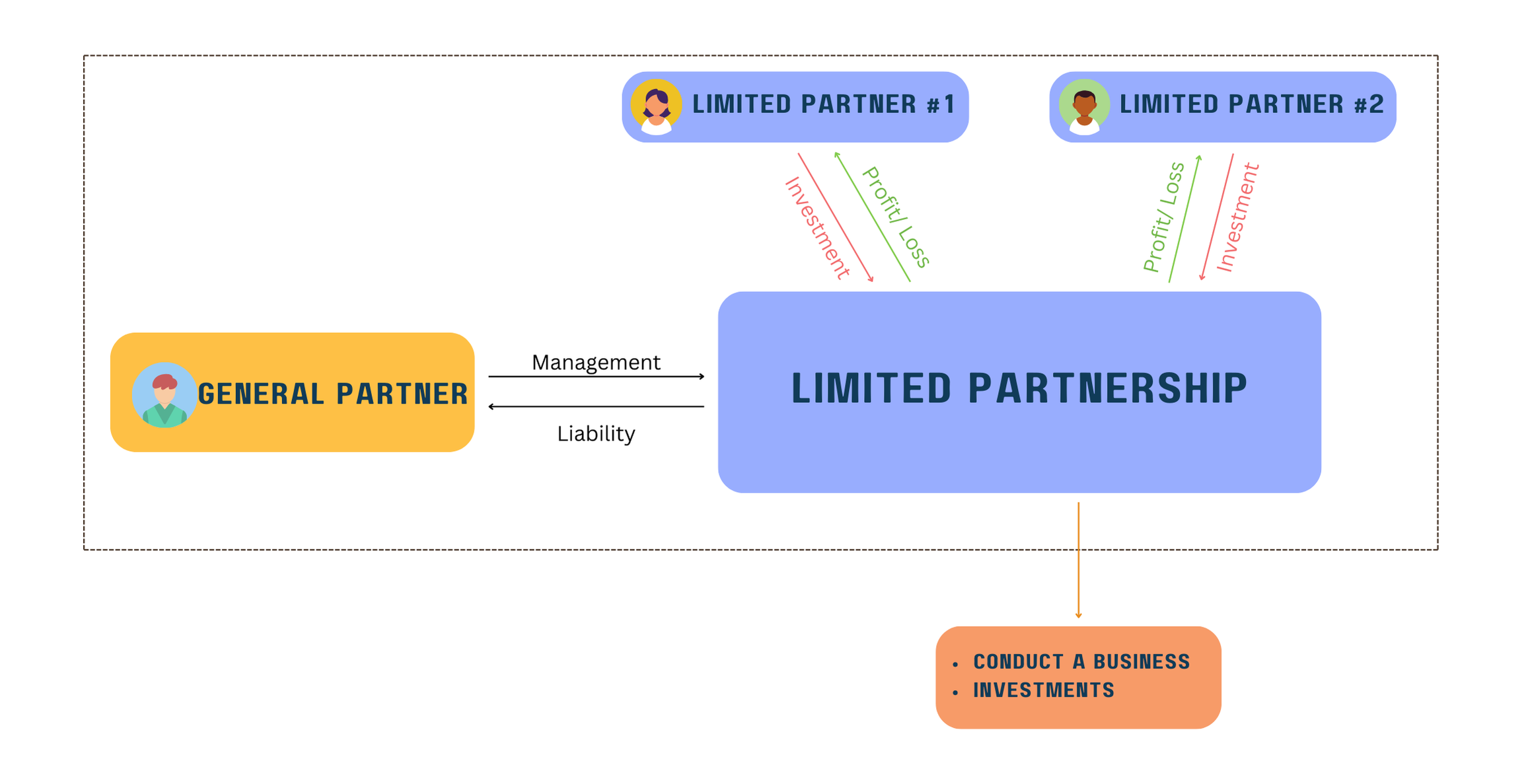
Limited partnerships are a corporate structure that combine some key features of companies (such as separate legal personality) and partnerships (such as tax pass-through treatment).  In a limited partnership, on entity is the general partner(s) who manage(s) the limited partnership (day to day running) while other investors are limited partners who act as silent partners (see diagram below).

This structure is often used by venture capitalists or fund managers as the corporate vehicle for investor partners to invest their funds.  For more information on the basic requirements of a limited partnership, along with a comparison of other structures, please see here.

Why choose a Limited Partnership?

Positive Comment
Liability is ring-fenced A limited partnership is a separate legal entity, and limited partners’ liability is restricted to contributed capital
Effective practical and legal control Only general partners may manage the affairs of the limited partnership
Tax pass-through treatment Tax consequences of the limited partnership pass directly to the partners
Privacy Identity of limited partners and contents of partnership agreement do not have to be publicised


Why wouldn’t I choose a Limited Partnership?

Drawback Comment
General partner is jointly liable with the limited partnership for the liabilities of the limited partnership Often addressed by choosing a limited liability company to act as general partner, providing liability ring-fencing
More involved set-up All limited partnerships require a written partnership agreement
Investors negotiate their rights and obligations E.g. Right to remove/appoint general partner(s), exit rights, pre-emptive rights
Financial Markets and Conducts Act 2013 A partnership interest in a limited partnership may be a financial product requiring FMCA compliance

We have helped many founders and companies structure their business and each situation is unique.  If you think a limited partnership may be a suitable option for your business, feel free to reach out if you would like specific input on your context.

If you enjoyed this content then we also have a guide for people doing business in New Zealand which you can download for free here.


There are many business structure options in New Zealand, including companies, partnerships and Trusts, and you want to be sure you are picking the right one. We frequently assist clients who are considering starting a business navigate the different business structure options to find what best suits their needs. The various business structure options each have their own pros and cons. What the best structure is for you will depend on your particular circumstance, desire and purpose.

The simple and easy structure which are well understood, such as a Company or Sole Trader, will work best for most businesses. If you are purpose driven, a Charitable Trust or Incorporated Society may be more appropriate. Increasingly we are also working with clients who want to merge both purpose and profits and for these clients we assist by creating unique dual structure approaches. In this article we have summarised the key points for the most common structures that are used in New Zealand. We are happy to meet and discuss options with you.

Two other critical points before we look at the options:

  • Get your strategy and purpose right before you decide on a legal entity type to use. Each one has positives and negatives so know what your end goal and the impact you want to see is first – after that look at which will help you get there.  They are each just tools for empowering you to have impact.
  • Second, we are offering legal thoughts on key elements of these structures but there are other considerations too – in particular always ensure you get great accounting and tax input on the financial side of these alternatives.

Now turning to the options:

Company
Who Owner = Shareholder
Manager = DirectorThe owners may also be the manager
Liability Is a separate legally recognised entity
Laws The Companies Act 1993 governs companies
Who signs The Director
If things go wrong Companies limit liability for the owner*
Key documents None required.
Can choose to adopt a constitution or shareholders agreement
Visibility Ownership and management is publicly visible on Companies Register
Difficulty to start Moderate

* There are certain limited circumstances when the owners of the company may be liable. If the owners are also managing the company as directors, they are exposed to certain liability as managers.


Sole Trader  
Who Owned and managed by ‘sole’ owner
Liability Not separate from entity
Laws No specific law governs sole traders
Who signs The owner
If things go wrong The owner is personally liable
Key documents None required
Visibility Private and not registered
Difficulty to start Easy


Partnerships
Who Owner = the Partners
Manager = the Partners manage
Liability Not separate from entity
Laws Partnership Law Act 2019
Who signs Partners
If things go wrong Owners are personally and jointly liable
Key documents None required
Can choose to have a Partnership Agreement
Visibility Private and not registered
Difficulty to start Moderate

* One owner can bind all owners.


Limited Partnership
Who Owner = Limited Partner
Manager = General Partner
Liability Is a separate legally recognised entity
Laws Limited Partnership Act 2008
Who signs The General Partner
If things go wrong The General Partner
Limit liability for the owner**
Key documents Requires a Limited Partnership Agreement
Visibility Private for the Limited Partners, public for General Partner
Difficulty to start High

* Each Limited Partner will account for tax in accordance with its individual tax position.

** If the owner participates in the management of the business, they will be liable.


Unincorporated Joint Venture
Who Owners = Partners
Management determined by the Joint Venture Agreement
Liability Not separate from entity
Laws Contract law, but no specific law governs Unincorporated Join Venture
Who signs Each partner
If things go wrong Partners separately liable or as decided by the Joint Venture Agreement*
Key documents None required
Can choose to have a Joint Venture Agreement
Visibility Private and not registered
Difficulty to start High

* Owner will account for tax in accordance with its individual tax position.


Trading Trust
Who Owner = settlor/donor gives assets (trust fund) to the Trading Trust on trust for the benefit of the beneficiary
Management = the Trustee Company,  manages the trust fund and pass on benefits to the beneficiary
Liability Not separate from entity, creates an equitable relationship
Laws Trusts Act 2019 and Companies Act 1993
Who signs The Trustee Company
If things go wrong The Trustee Company
Key documents Trust Deed
Visibility Private and not registered
Difficulty to start High


Charitable Trust
Who Owners = settlor/donor gives property (trust fund) to the Charitable Trust to benefit the community through charitable purposes
Management = Trustees manage the trust fund to advance the charitable purposes
Liability Is a separate legally recognised entity
Laws Trusts Act 2019 and Charitable Trust Act 1957
Who signs The Trustees
If things go wrong The Trustees
Key documents Trust Deed
Visibility Registered on Charitable Trust Register and if a registered charity on Charities Services
Difficulty to start Moderate


Incorporated Society 
Who Management = the Committee manages the funds to advance the purpose
Liability Is a separate legally recognised entity
Laws Incorporated Society Act 2022*
Who signs The Committee, but this depends on the Constitution
If things go wrong The Committee
Key documents Constitution
Visibility Registered on Incorporated Societies Register and if a registered charity on Charities Services
Difficulty to start Moderate

* This is a new Act which has recently come into force, for more information on the new Act and requirements see our Incorporated Societies Act 2022: Information Hub.

Co-operatives Companies
Who Owner = Members/shareholders
Governance = Directors
Liability Is a separate legally recognised entity
Laws Co-operative Companies Act 1996 and Companies Act 1993
Who signs The Directors
If things go wrong Companies limit liability for the owners
Key documents Constitution
Visibility Registered on Companies
Difficulty to start Moderate

For lots more information on co-operatives visit Cooperative Business New Zealand – https://nz.coop/

If you have any further queries please do not hesitate to contact one of our experts at Parry Field Lawyers- stevenmoe@parryfield.comyangsu@parryfield.comsophietremewan@parryfield.com, or annemariemora@parryfield.com

This article is general in nature and is not a substitute for legal advice. You should talk to a lawyer about your specific situation. Reproduction is permitted with prior approval and credit being given back to the source.