
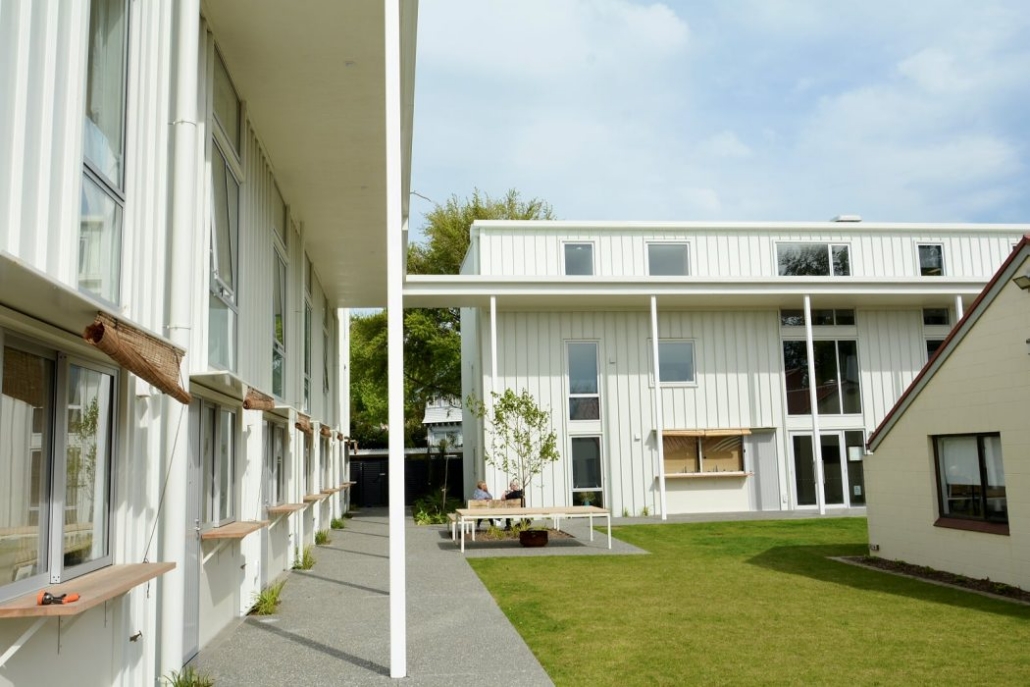
After the 2010-2011 Canterbury earthquakes destroyed its historic central Christchurch building, Oxford Terrace Baptist Church chose not simply to rebuild a place of worship, but to reimagine its land as an integrated hub for housing, work, worship, and community connection.
The completed development brings together church facilities, office spaces, shared community spaces, and 14 apartments on a centrally located site.
The residential component includes five two-bedroom, six four-bedroom and three five-bedroom apartments, providing a mix of homes for families, young adults and residents with accessibility needs. Half of the apartments are allocated to applicants on the social housing register and to refugees who need stable, secure accommodation and wraparound support, with the balance available for family housing or rent-by-the-room accommodation for first-year students and young adults.
Within the housing development, there is intentional connection with the Oxford Terrace Baptist Church, with three families from the church living within the 14 housing units. The residents who have chosen to live in the Housing Community believe in the neighbouring kaupapa, with a shared sense of fostering community and connection to create a modern-day monastery where people can live, work, and worship together.
The project demonstrates how a faith-based organisation can use strategically located land to respond to housing need while retaining a clear community and mission focus. It also illustrates the wider potential for churches and other mission-aligned landowners to unlock land for social
and community benefit.
This project raises the following key points of interest:
- Mission clarity: the project demonstrates how a faith-based landowner can respond to a significant loss of built form by reimagining its land for a broader community purpose. Following the Canterbury earthquakes, Oxford Terrace Baptist Church chose to develop spaces where people could live, work, and worship. This clear mission focus appears to have shaped the housing, office space, community, and worship elements of the development from the outset.
- Church-held land can unlock housing: the project is a strong example of how centrally located church land can be used to provide housing outcomes in high-value urban locations. Rather than treating the site solely as a replacement church building, the land was used to deliver 14 apartments, including larger family-sized homes and accessible units. This demonstrates the potential for churches and other mission-aligned landowners to contribute meaningfully to housing supply.
- Mixing use and tenure supports viability: the mix of social housing, refugee accommodation, family housing and rent-by-the-room accommodation creates a diverse resident community which is strengthened by the intentional involvement of three church families living within the development, helping to foster a shared kaupapa of community, connection, support and belonging. This approach supports community development while also requiring careful consideration of eligibility, tenancy management, affordability settings, and long-term operational sustainability.
- Good design supports social outcomes: the shared garden, central courtyard, vegetable garden and orchard all support neighbourly connection and provide safe common areas for tamariki and families. The inclusion of warm apartments, shared facilities, bike and storage sheds, plus the opportunity to access free community internet and below-market-rate solar power also demonstrates how design and amenity can contribute to practical wellbeing.
- Steward your partnerships: a development of this nature requires alignment between the church’s mission, the needs of residents, social housing allocation pathways and the ongoing management of shared spaces. Oxford Terrace Baptist Church has not only enabled the physical development, but has also continued to steward the shared kaupapa that underpins t, intentionally nurturing connection between the church and housing communities through the presence of church members living onsite, and supporting the longterm community development, belonging and mutual care that sit at the heart of the model.
Awards and Recognition:
- Housing Multi-Unit Winner, 2026 Canterbury Regional Architecture Awards
- Gold Award and National Category for Multi-Unit Housing Winner, New Zealand Commercial Project Awards 2025
- Public Architecture Winner, 2019 Canterbury Regional Architecture Awards
For more on the Oxford Terrace Housing Community, visit the website at: otbc.org.nz/facilities-housing/housing

