We have helped many incorporated societies transition into charitable trusts and an issue that always arises is what happens to bequests to the incorporated society? The answer, in short, is “it depends”. This article will look at two situations; what happens to bequests when the incorporated society is wound up and what happens when the incorporated society is left as a shell entity.

Wound up incorporated society

Firstly, if a gift is left to an incorporated society that has been wound up, the executer would look to supporting documents that show a relationship with the trust and whether it is essentially the same entity. This would include, for example, the background section of the trust deed and the resolution to wind up and transfer assets from the society to the charitable trust.

The court may need to get involved if the executer is not satisfied the charitable trust is essentially the same as the incorporated society or where the wording of the Will is clear that the funds are only to go to the society. In this unlikely case, the court will seek to carry out the wishes of the Will-Maker when deciding which charitable entity to gift the funds to.

This means that even where there is a background section in the trust deed, there is no absolute certainty that the charitable trust will receive a bequest meant for the society. It is likely they will, due to the clear documentation that the charitable trust is essentially the same as the society, but there still remains a risk. Unfortunately, we have talked to MBIE about this and they cannot make any regulations for the new Act to remove this risk.

It is therefore advisable that if your incorporated society has transferred to a charitable trust, that you get in touch with your supporters and let them know they should amend their Wills. If you need help with this wording please do not hesitate to contact one of our experts here at Parry Field Lawyers.

Shell incorporated society entity

Secondly, whether bequests are paid to the charitable trust when the Will states it is to an incorporated society and/or quotes the charitable trust depends on what the Will says, how the executor feels about the bequests and if the residuary or other beneficiaries will raise issues.

Where a Will is clear that the bequest is for the incorporated society and it contains the Companies Office number or Charities Service number, the executor will generally be able to find the contact details for the society. It could then be explained to the executor that the charitable trust is undertaking the same work as the incorporated society. It will be at the executor’s discretion as to whether they transfer the funds to the charitable trust directly or require the funds to be transferred to the incorporated society. It would be prudent for the incorporated society to keep a bank account and to be active for this very reason, so it can transfer any bequests made to it.

The executor may be a close relative (e.g. child) of the Will-Maker who is aware of the Will-Maker’s wishes and can interpret the gift left in the Will to the society as being meant for the charitable trust. By contrast, the executor might be distanced from the Will-Maker or unaware of their involvement in the charitable trust and therefore unwilling to make the gift to the society.

A situation may arise where a beneficiary of the Will is challenging the gift made to the society, in which case it could be helpful to avoid any challenges to the validity of the gift itself.

These may be a reason to keep the society as a shell entity, to avoid a lot of these situations. It is prudent to consider how long you should leave the incorporated society as a shell for, as there may be some people who have drafted their Wills recently but won’t pass for a long time.

Some Wills contain a clause which discusses the “successor” entity which that would work in the charitable trust’s favour.  Alternatively, some Wills say that if a gift fails then it gets added to the residue, or if the provision falls short, then it automatically gets added to the residue, this would not be in the charitable trust’s favour.

We have helped many incorporated societies transition to a charitable trust and have an incorporated society information hub here and a charitable trust information hub here. This article is not a substitute for legal advice and our experts here at Parry Field Lawyers would be happy to answer any of your questions.

If you would like to discuss further, please contact one of our team on stevenmoe@parryfield.com sophietremewan@parryfield.com  or annemariemora@parryfield.com .
In the context of contract law, understanding the differences between assignment and novation is important for effectively managing contractual relationships and obligations. They have significant differences in terms of their legal implications and requirements.

Assignment

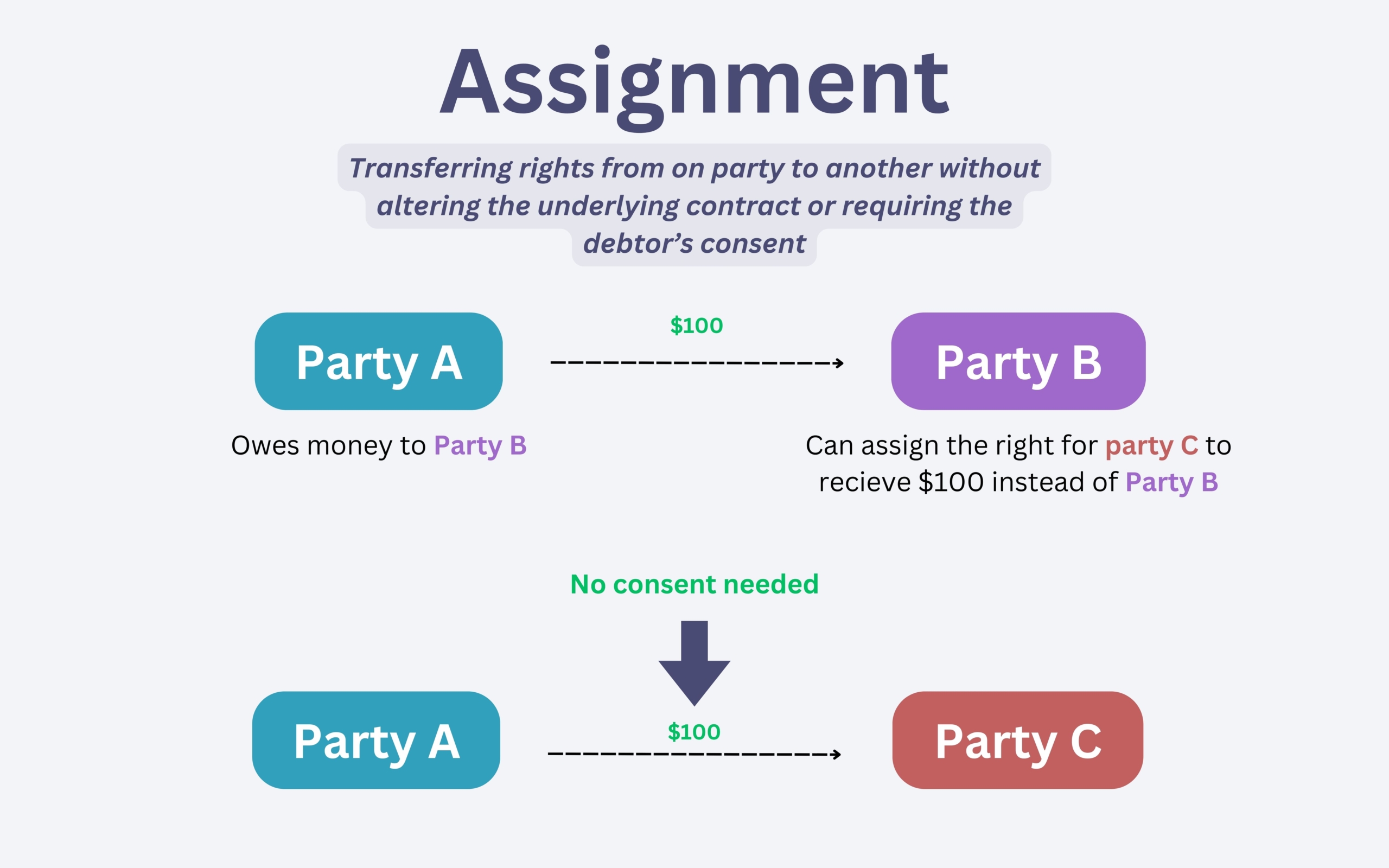
Assignment involves the transfer of rights from one party (the assignor) to another (the assignee) without altering the underlying contract or requiring the debtor’s consent. Key points include:

  • Transfer of Rights: Only the benefits or rights under the contract are transferred. The assignor retains their obligations.
  • Consent: The debtor’s consent is not required for the assignment to be effective. However, the assignee cannot be imposed with obligations without their consent.
  • Notification: It is generally good practice, although not always legally required, to notify the debtor of the assignment.

For example, if Party B is owed money by Party A, Party A can assign the right to receive payment to Party C without needing Party A’s consent.


Novation

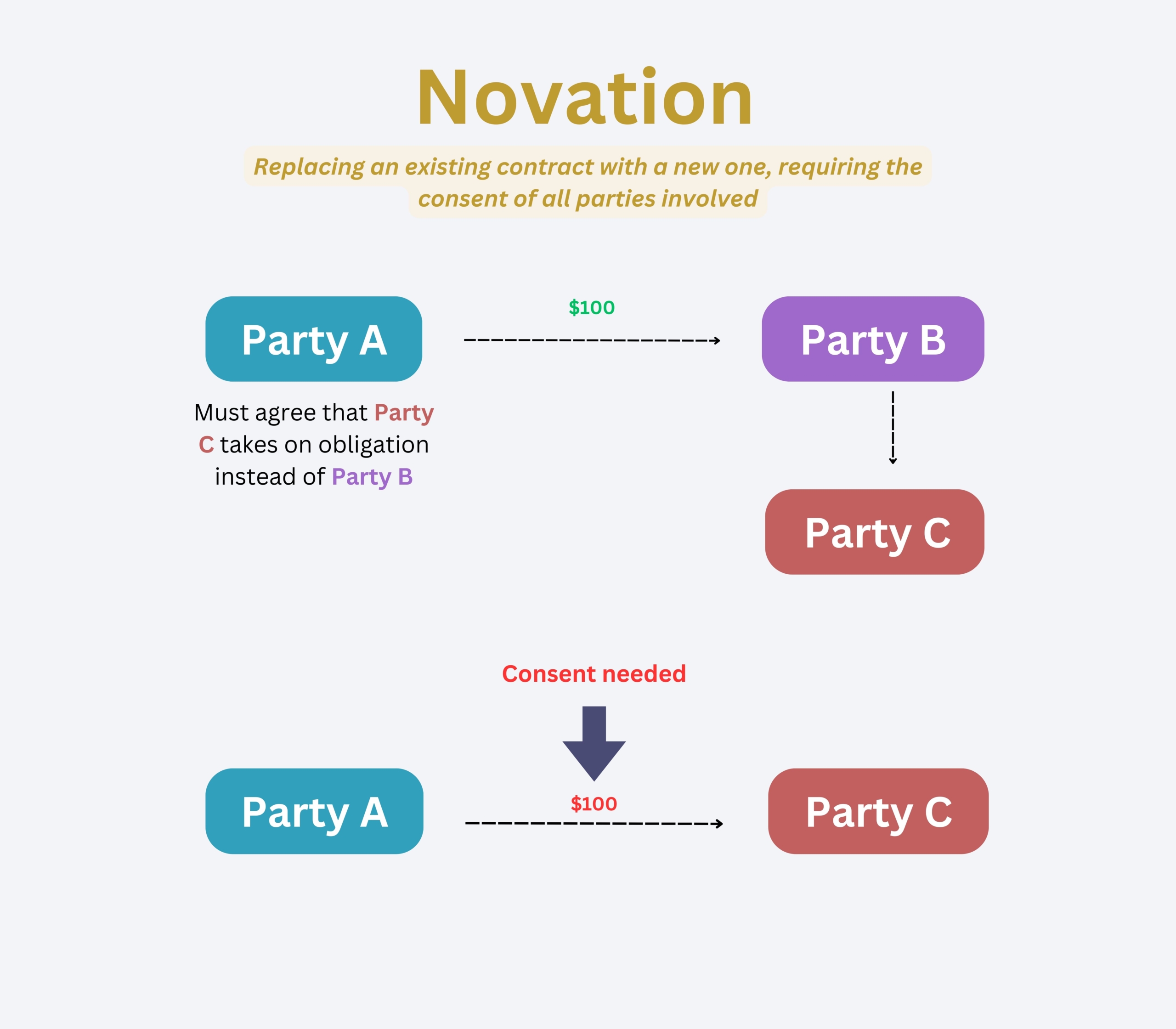
Novation, on the other hand, involves the replacement of an existing contract with a new one, requiring the consent of all parties involved. This creates a completely new contractual relationship and extinguishes the original contract. Key aspects include:

  • Substitution of Parties: A new contract is formed where a new party (the novatee) replaces one of the original parties (the novator), with the consent of the remaining original party.
  • Discharge of Obligations: The original contract’s obligations are discharged, and a new set of obligations is created under the new contract.
  • Consent Requirement: All parties involved must consent to the novation for it to be valid.

For example, if Party A owes Party B $100, and Party B agrees to transfer this obligation to Party C, with Party A’s consent, a new contract is formed where Party A now owes $100 to Party C, and Party B is released from the original obligation.


Legal Distinctions

The main differences between assignment and novation lie in the nature of the transfer and the necessity for consent:

  • Assignment: Transfers rights only and does not require the debtor’s consent.
  • Novation: Transfers both rights and obligations, discharging the original contract, and requires the consent of all parties involved.

In summary, assignment allows for flexibility in transferring rights without complicating the original contract, while novation provides a clean slate by forming a new contractual relationship. Each mechanism serves different strategic needs, depending on whether one wishes to transfer benefits alone or completely restructure obligations and parties involved.

We assist a wide range of clients with all aspects of commercial law. Please do get in touch if you would like assistance.  Contact Steven Moe at stevenmoe@parryfield.com or Aislinn Molloy at aislinnmolloy@parryfield.com.

Many organisations choose to hire out their venues to the public when the venues are otherwise unused. While this can be an excellent way of bringing in funds, there are some pitfalls to be aware of including intentional or unintentional discrimination.

Discrimination on the basis of religion

In 2012, a Catholic Priest in the United Kingdom sought to ban its church hall being used for ‘spiritual yoga’, [1]  which was thought to be incompatible with the Catholic faith. Even if the yoga was incompatible, excluding the yoga teacher on the basis of religion would be illegal in New Zealand and grounds for a complaint of discrimination.

It may seem counter-intuitive that one religion cannot prevent people from an incompatible religion using their facilities, yet that is what the law says. [2]  Anyone who provides goods, facilities or services to the public or a group of the public cannot discriminate based on religion.[3] This includes treating someone less favourably based on religion when providing goods, facilities, or services.

If someone feels they are being discriminated against, they are entitled to make a complaint to the Human Rights Commission[4] or to take the matter to the Human Rights Review Tribunal.[5]

The legal test for whether behaviour is discriminatory is[6]:

  • Is there differential treatment or effects as between person or groups in analogous or comparable situations on the basis of a prohibited ground of discrimination; or
  • Does that differential treatment impose a material disadvantage.

If we apply this to the example of the church above, the yoga teacher may have been able to establish that they were discriminated against if the church hall had been readily hired by other members of the public or other religious groups. Banning the yoga teacher would arguably then have been ‘differential treatment’.

Can a church legally limit who uses its venues?

Section 44 of the HRA says it is unlawful for any person who supplies goods, facilities, or services to the public or to any section of the public to refuse or fail on demand to provide any other person with those goods, facilities, or services, by reason of any of the prohibited grounds of discrimination. Religion is a prohibited ground of discrimination. When it comes to a venue, the key word is ‘public’.

Going back to the example above, one option would be for the church to have a policy that its facilities are for private use, but exceptions can be made on a case-by-case basis and subject to availability. This would give the church some discretion regarding who uses its facilities and would mitigate against accusations of discrimination. The downside is that the the venue might miss out on valuable funds from hiring its venues out publicly.

Another option would be to limit which parts of a venue or facility are able to be rented out.


This article is not a substitute for legal advice and our experts here at Parry Field Lawyers would be happy to answer any of your questions.

We have assisted a number of churches with ensuring their rental provisions comply with the law –  we would be delighted to assist you to. If you would like to discuss your options, please contact stevenmoe@parryfield.com  or annemariemora@parryfield.com.


[1] https://news.sky.com/story/catholic-church-bans-hindu-yoga-classes-10468941#:~:text=Instructor%20Cori%20Withell%20said%20the,was%20a%20Hindu%20religious%20activity.

[2] Human Rights Act 1993, section 21(1)(d).

[3] As above, section 44(1)(a) and (b).

[4] https://tikatangata.org.nz/resources-and-support/make-a-complaint

[5] https://www.justice.govt.nz/tribunals/human-rights/

[6] Ministry of Health v Atkinson [2012] NZCA.

An executor has a duty to carry out the provisions of the will.

What should an executor do when beneficiaries or family members are not provided for under the will or have issues with the will?

An executor’s primary duty is to carry out the directions of the will (see this article for details about that duty). Therefore, it is not usually appropriate for you as an executor to agree to a compromise with a complainant without the approval of all the beneficiaries.

Once a claim has been made, the Estate cannot be distributed to the beneficiaries until the matter is resolved. It is in everyone’s interests to obtain a speedy resolution.

Thankfully, disputes can often be resolved (with or without the need for proceedings). As an executor, you should help provide a space for settlement discussions to take place.

If all the beneficiaries of the will agree to a resolution, they can sign what is referred to as a Deed of Family Arrangement, which sets out the basis on which they want the Estate to be distributed.

As an executor, you will want the terms of the Deed of Family Arrangement to protect from any potential claim that you breached your duty as an Executor. We have experience drafting these documents so please contact us for assistance.

What happens if matters go to Court?

When a claim is made against an Estate, it is made against the Executor as the named party. Usually the Estate is liable for the associated legal costs, not the Executor personally. (There are exceptions if the Court finds that the Executor took inappropriate actions which increased the costs of the proceedings).

The appropriate response for an executor to court proceedings depends on the type of claim being made.

If the claim is under the Family Protection Act 1955, the Executor’s duty is to accurately inform the Court of the Estate’s assets and liabilities and any other relevant information about the Estate. The Courts have held that the Executor should not actively defend the proceedings (i.e. they should not try and prove that the provisions of the will should be followed). It is only other beneficiaries of the will that are able to take that active defence.

For claims made under the Law Reform (Testamentary Promises) Act 1949, the Executor is entitled to defend the proceedings. However, if the beneficiaries of the Estate are opposing the claim, the executor can take a neutral stance.

If the claim is being made by an alleged creditor of the Estate, the Executor should actively defend the proceedings if it considers that the creditor’s claim is not legitimate.

Please see these articles for more information about Family Protection Act and Testamentary Promise claims.

We have experience assisting Executors to manage claims against an Estate, and to assist beneficiaries in negotiating a resolution. Please contact us to see how we can help you.


This article is general in nature and is not a substitute for legal advice. You should talk to a lawyer about your specific situation. Reproduction is permitted with prior approval and credit being given back to the source. 

What happens if a family member does not provide for you in their will?

It is always difficult when a loved one passes away. But this can be made significantly worse when someone discovers that they have not received the provision under the will that they expected. What can you do if you think you have not been properly provided for?

The law provides for  certain family members to challenge a will on the basis that the will-maker did not adequately provide for them under the Family Protection Act 1955.

Who can make a claim?

The Family Protection Act entitles the following people to make a claim:

  • the spouse or civil union partner of the deceased;
  • a de facto partner who was living in a de facto relationship with the deceased at the date of his or her death;
  • the children of the deceased;
  • the grandchildren of the deceased;
  • the stepchildren of the deceased (if they were being maintained wholly or partly or were legally entitled to be maintained wholly or partly by the deceased immediately before his or her death); and
  • the parents of the deceased (in limited circumstances).

There is no provision for siblings of a deceased to make a claim.

What does it take for a claim to succeed?

To succeed, a claimant must convince the Court that the will-maker failed to “provide adequately for the claimant’s proper maintenance and support”. This does not just reflect economic need, but also the importance of recognising a claimant’s importance as part of the family.

It’s important to note that mere unfairness or disparity between beneficiaries is not sufficient to bring a claim under the Family Protection Act (for example, that one sibling got less than the others).

The success of a claim will depend on the particular facts of the case, but relevant factors include:

  • The economic need of the claimant;
  • The size of the Estate and the competing moral claims of other family members and beneficiaries under the will;
  • The duration and nature of the claimant’s relationship with the deceased;
  • Any gifts made to the claimant during the deceased’s lifetime; and
  • Whether there was a rift between the deceased and the claimant and, if so, who was responsible for that.

If successful, the Court is still limited to awarding no more than what is necessary to give adequate provision. The Court will not rewrite a will on the basis of what someone else considers to be fair.

Timeframe for a claim

In order to be effective, a claim must be brought against an Estate before the funds of the Estate have been finally distributed to the beneficiaries.

Where an executor has no notice of any claim against the Estate, the executor can distribute the Estate’s assets 6 months after probate is issued.

Under the Administration Act 1969,  a potential claimant can prevent distribution of the Estate for 3 months if notice is given to the Executor that he or she intends to challenge the Estate. To get the most out of this 3 month window, notice of intention should be given just prior to 6 months after probate. This extension can only be obtained once, after which the Executor is safe to distribute if no Court proceedings have been served on the Estate.

Any claim must also be brought within 12 months from the date of probate (we explain probate in this article). A claimant can apply to the Court for leave to extend this timeframe, but extensions are rare and will only succeed if the Estate has not already been distributed.

How to make a claim

A Family Protection Act claim can be brought in either the Family Court or the High Court. The appropriate court will depend on the size of the estate, the complexity of issues, and whether there are already other proceedings relating to the Estate.

The documents required to initiate a claim differ depending on which Court is being used.

Once a claim is brought, it will need to be served on the Estate and other beneficiaries, who can then choose to oppose the application. Where a claim is opposed, the Court will usually ensure that the parties have the opportunity to attend some form of mediation to try and resolve the dispute without the need for a full hearing.

We have experience in both bringing and defending claims in both courts, and in resolving disputes between beneficiaries. Please contact us to see how we can be of assistance.


This article is general in nature and is not a substitute for legal advice. You should talk to a lawyer about your specific situation. Reproduction is permitted with prior approval and credit being given back to the source. 

Trustees have important duties. If a trustee lose their mental capacity and cannot perform their trustee duties, action is needed in the best interests of the trust, and arguably in the best interests of the trustee themselves. So what happens?


What is meant by ‘loss of capacity’?

The Trusts Act 2019 (the Act) does not define what this means (except when it refers to people who are subject to an order appointing a manager under the Protection of Personal and Property Rights Act, or has a trustee corporation managing the person’s property under that Act).

Broadly speaking and depending on the circumstances, a trustee will have lost capacity if they do not have the capacity to make the future decisions required for their role as trustee. It is also useful to be aware that ‘capacity’ has been interpreted by the courts in numerous ways, depending on a variety of circumstances, including what the affected trustee is responsible for doing.

In New Zealand people are presumed to have mental capacity until proven otherwise. We suggest that only an appropriately qualified medical practitioner can truly make this evaluation. Not only is a medical practitioner’s decision authoritative, it is made independently from other trustees.


What needs to happen if a trustee loses capacity?

There may be negligible or substantial risks attached to an incapacitated trustee remaining in office. The more substantial the risk, the greater the need for action. Those affected by a trustee’s decision-making may need to be protected from potentially imprudent decisions, for example.

A trustee may or may not recognise that they have lost or are losing their capacity. If they do not recognise this and fail to remove themselves from the role, it falls to others to act.


The law is clear

The Act recognises the necessity of dealing with this issue. Anyone who “lacks the capacity to perform the functions of a trustee” is legally disqualified from being a trustee. Furthermore, a trustee who lacks capacity is legally required to be compulsorily removed from the role by the ‘person with power to remove trustees’ to act to remove them.


Who is the ‘person with power to remove trustees’?

The Trust Deed will normally state who has this power, and failing that, the other trustees are empowered to act. If the trustees are unwilling to act, a person holding an enduring power of attorney over the property of the trustee who is mentally incapable may act. Other options are set out in the Act.


What is the process for removing a trustee?

In most circumstances you can follow the process set out in your Trust Deed, or the process set out in the Act. If you are following the Act, you must give the affected trustee 20 working days’ notice in writing of their removal.

The affected trustee may make an application to prevent their removal within 20 working days of receiving notice of the removal decision. The affected trustee will need to produce evidence that raises a genuine dispute as to whether the removal decision was open to the person who made the decision. If the court finds that this evidence is sufficient, the onus then returns to the person who made the decision to remove the trustee to show the decision was reasonably open to them. (That is why it is advisable to have a reputable medical evaluation.)  We recommend seeking legal assistance if things reach this stage.


How to give notice to a trustee

So many issues can be avoided by choosing the correct words. Our rule of thumb is to treat a trustee who has lost their capacity as you would like to be treated in the same circumstances. Although you are acting to remove the trustee, compassion is recommended as it is likely to minimise any unintended offence.


What if an incapacitated trustee refuses to leave?

The law makes provision for this situation because unfortunately it does arise—the court may make an order for removal. We suggest you seek legal assistance in this situation.

This article provides an overview but it is not a definitive guide. For further assistance, please contact one of our team. You may also find this article about Enduring Powers of Attorney of interest.

If you have any further queries please do not hesitate to contact one of our experts at Parry Field Lawyers- stevenmoe@parryfield.comyangsu@parryfield.com, sophietremewan@parryfield.com or annemariemora@parryfield.com

This article is general in nature and is not a substitute for legal advice. You should talk to a lawyer about your specific situation. Reproduction is permitted with prior approval and credit being given back to the source. 

Raffles are a common way to raise money for worthy causes. What may surprise you is that there are laws that govern how raffles need to be run. For example, it is illegal to run a raffle online. It pays to be aware of the rules before organising a raffle. Here are some important things to know.


Where are the rules?

The laws around raffles are found in the Gambling Act which exists among other reasons to ensure the integrity and fairness of games, and ensuring that money from gambling benefits the community. It’s useful to keep in mind that these laws are not there to make life difficult but to guard against improper use of funds.


What can raffles be used for?

The raffle proceeds can be used for a charitable purpose, or a non-commercial purpose that is beneficial to the whole or a section of the community. So raising money for a registered charity is fine, as is raising money for the local football club. It is not acceptable for someone to run a raffle to raise money so they can go on holiday or buy a new laptop.


What prizes are permitted?

Most prizes will be fine to raffle. However, alcohol and tobacco products prizes are illegal, as are firearms, explosives, restricted weapons or airgun. It is also illegal to offer a taonga tuturu as a prize (an object over 50 years old that relates to Māori culture, history or society  and was manufactured, modified, used or brought into New Zealand by Māori), or a voucher or entitlement to commercial sexual services.


A licence is sometimes needed

Most small raffles are pretty straightforward to run. However, if the combined value of prizes is more than $5,000, and the turnover (the money raised) is more than $15,000, a Class 3 licence is needed. Apply for a licence on the DIA website.


What’s involved in a Class 3 licence?

Among other things, there are special requirements for what needs to be on the tickets. The prize needs to be worth at least 20% of the prize’s ‘gross potential income’ (which is the amount you expect to raise, calculated by multiplying the number of tickets by the cost of each ticket). Within 3 months of the raffle finishing the organisers must provide an audited Audit and Prize Statement to the Secretary. More information is set out on the DIA website.


Other rules

Even if you do not need a licence, there are other rules to be aware of, including:

  • The rules for the competition must be clear to all participants.
  • If tickets are sold to the general public, the time and location of the prize draw must be open to the public.
  • Prizes can only be given to winners and must be given to winners within 3 months of the result, unless the winner cannot be identified or located or does not accept the prize. Prizes cannot be changed once the raffle has started.

This article is general in nature and is not a substitute for legal advice. You should talk to a lawyer about your specific situation. Reproduction is permitted with prior approval and credit being given back to the source. 

As you may know, all incorporated societies in New Zealand must re-register under the new Incorporated Societies Act 2022 (the “new Act”). If this is news to you, we have written an article about it here.

The new Act requires a society’s name to end with either ‘Manatōpū’, ‘Incorporated’ or ‘Inc’ (or more than one of these if you so wish). However, to change your society’s name, even just one word, you must reregister first then apply to the Registrar for a name change.

To change the name of your society, you need a RealMe® login, an Incorporated Societies Register online services account, and you need the requisite authority in your society to manage information on your society’s register. You need to log into your online services account and select ‘Name Change’ on the ‘View Details’ page and type in the new name. You may click ‘Name availability check’  to make sure you can use the name. If there are any documents in support of your name change (i.e. if another entity has provided consent for you to use the name) you should include these. Then, after completing the signatory details you can submit it. See Companies Office for more information about naming your society here.

The Registrar must then approve the name and will send an email confirmation that they have registered the change within three working days. An updated Certificate of Incorporation will be sent to you. You do not need to update your society’s constitution as it will be treated as having the new name; however, this should be done in your next general meeting.

We have supported many incorporated societies and produce many free guides and resources on our Incorporated Societies information hub here. This article is not a substitute to legal advice and if you have any questions please do not hesitate to contact our experts here at Parry Field Lawyers.

We help with unincorporated and incorporated societies and answer questions all the time. If you would like to discuss further, please contact one of our team on stevenmoe@parryfield.com   sophietremewan@parryfield.com  or annemariemora@parryfield.com.

Payroll giving occurs when employers enable their employees to make donations directly from their gross wages. The tax benefit is that the amount of PAYE or withholding tax the employee pays is reduced by the amount of their donation. They also receive a ‘tax credit’ from the donation, which is 33.3% of the donation value.

Payroll giving is therefore a bit simpler than making a donation directly to a charity as donors do not have to submit their donation receipts to IRD to claim the tax credit.


What needs to be in place for payroll giving?

Employers will only be able to offer this service if they file their payroll taxes electronically. They can either use the myIR online service, or attach files from their own payroll software.

Even if an employer has the ability to use payroll giving, it is discretionary. Employers may also use their discretion to choose how the donations will operate, for example, they may designate specific charities that can be donated to, and they may designate a minimum donation amount.

Only ‘tax donee’ organisations can receive payroll donations.


What is a donee organisation?

IRD maintains a list of donee organisations. Charities are added to the list if they use at least 75% of their funds within New Zealand (that is, they operate “wholly or mainly” here), or for the public good if an organisation is not a charity. For more on the threshold, you can check to see if a charity is on the IRD donee organisation list here.


Other resources

The IRD has put together this excellent guide to payroll giving.

It is also possible to claim tax credits on donations to charities supporting overseas causes.


This article is general in nature and is not a substitute for legal advice. You should talk to a lawyer about your specific situation. Reproduction is permitted with prior approval and credit being given back to the source. 

If you would like to discuss further, please contact one of our team, stevenmoe@parryfield.com, or annemariemora@parryfield.com at Parry Field Lawyers.

What duties apply to an executor?

We assist many people to prepare their wills, as well as helping executors to manage estates. A common question we get is “what duties apply to an executor?” To keep you safe, we outline here the key duties you should be aware of.

What is an executor?

  • An executor is the person a will-maker appoints to carry out their Will when they die.
  • An administrator is the person appointed by a court to administer a deceased person’s estate (usually where the person died without making a will, this is called dying “intestate”).
  • This article primarily focuses on executors, but the general duties and comments about resolving Estate disputes will be of equal relevance to administrators.

What are the responsibilities of an executor?

After an executor has been appointed, all property of the deceased will immediately come under the legal ownership of the executor (on behalf of the Estate).

The duties of an executor include:

  • To gather in all of the deceased’s assets;
  • To bury the deceased and pay for funeral expenses out of the Estate’s assets;
  • To pay any debts owed by the will-maker; and
  • To distribute the remaining assets in accordance with the will or intestacy laws.

In all of your actions as an executor, you owe duties to the beneficiaries of the Estate to act in their interests, rather than your own. An executor must also act even-handedly or fairly between the beneficiaries.

We have assisted many people to manage their responsibilities as executors and are happy to talk with you about how we could help you.


This article is general in nature and is not a substitute for legal advice. You should talk to a lawyer about your specific situation. Reproduction is permitted with prior approval and credit being given back to the source.